Category Archives: Environment

Bologna Book Fair 2024: Looking For New Trends

This year, the Bologna Children’s Book Fair (BCBF), the biggest fair in the world for children’s literature since it was launched 61 years ago, opened in Bologna, Italy, on Monday, April 8. Lasting for four days, it was a big success, drawing 1,523 exhibitors from 100 countries, with Slovenia as the guest of honor and China back in full force. I was among the many who attended, with over 31735 visitors according to the BolognaFiere Group, an increase of 10 percent over 2023.

Yet, as I will discuss below, the Fair felt different from last year, more like a turning point, as if we were on the verge of a new era. And it wasn’t just due to the rise of AI, which, after all, is just a new technology, nor was it a new trend in the world of ideas or a new category of books, like, say, romantasy.

Although to be sure, it was that too. But with books being banned in the United States (of all places, a country that was once upon a time a leading democracy, a paragon of virtue and freedom) and the rising challenge posed by social media and films to the publishing industry, siphoning away readers, especially among a key group, Middle Grade readers (age 8-12), the industry may well have to brace itself for some groundbreaking shift in the reading public’s interests and tastes.

Alas, the high level of sales achieved during the pandemic is now a thing of the past. And AI, seen by many as a threat, could also be an opportunity for publishers to try and cut costs – but at whose expense? How AI will impact the industry remains to be seen but one thing is certain, it will impact it in a big way.

And yet…Human creativity has never been so high, as the Fair amply demonstrated.

No doubt, fresh ideas and approaches to publishing were in full display. Boosted, inter alia, by the many new countries that joined the Fair this year for the first time: Angola, Belarus, Benin, Bolivia, Cameroon, Colombia, Luxembourg, Mauritius, Monaco, Moldova, Paraguay, the Philippines, Togo, and Uganda.

Attendance was also boosted by the Fair’s unique “brand extension” feature in the form of parallel presentations at Bologna Book Plus and the Bologna Licensing Trade Fair/Kids—bringing together promoters and showcasing content across the book publishing supply chain. And the Fair was amply covered by the international press with more than 40 journalists attending, including extensive reporting of all trade aspects by Publishing Perspectives.

Event at the Illustrators’ Café, April 8, 2024  Source: Author

There were 386 events at the Fair itself, and more than 220 additional events on and off-site, in other parts of the city which has a long tradition of welcoming artists and illustrators and numerous libraries featuring children’s books – not to mention the magnificent public library, the Sala Borsa.

And China was back in full force, with over 100 Chinese exhibitors and events like “Data Release and Case Analysis of the Chinese Children’s Book Market” provided insights into the booming Chinese market that services over 360 million children and young people with over 40,000 titles published each year. China also has its own major children’s book fair, the China Shanghai International Children’s Book Fair (CCBF), which takes place in November. 

The Bologna Children’s Book Fair: Looking for new ideas, from romantasy to graphic novels

As mentioned above, the pandemic that had caused a sudden boost in children’s book sales and a concerning drop in attendance at public events is now definitively behind us.

Pandemic peak sales are a distant memory; the world of children’s book publishing is back to normal, with book fairs around the world – notably the London Book Fair just over and the Frankfurt Book Fair coming up in October – acting as thermometers to figure out what’s hot. Publishers, editors, and agents are now realizing they may have gaps in their lists, and the middle-grade category (books for ages 8-12) is the most affected – although even YA (age 14-18), once the high-flyer among categories, is no longer the undisputed star.

As reported by Publishers’ Weekly, the current craze is for a new crossover genre termed “romantasy”, combining fantasy with romance.

And the other large emerging trend that has – depending on the viewpoint – “taken over” the middle grade category (books for ages 8 to 12) or “saved” it from collapse is graphic novels. And the Bologna Book Fair could not fail to have a large section dedicated to comics with publishers coming from every corner of the world:

This said the focus at the Fair remained firmly on illustrations and the world of author-illustrators, from picture books ranging for early readers to graphic novels for YA (young adults, ages from 14 to 18). At the core Illustrators Exhibition with its 58th competition, over 3,500 artists from 81 countries  made 17,600 submissions. In the end,  there were 344 finalists and  79 artists 78 sets from 31 countries made the most coveted list. 

The winners of the 2024 Hans Christian Andersen Award given for recognition for lifelong contributions were announced on the first day at the Fair and drew a large gathering: 

The winners were Heinz Janisch from Austria, a master of short-form stories that leave room for readers’ imagination; and Sydney Smith from Canada, recognized for his illustrations characterized by authentic characters and a focus on emotions.

The Fair featured a new theme for children: Sustainability

Through both an exhibition of some 70 titles focused on sustainability as well as a debate aptly titled “Reading For A Healthy Planet”, the objective was to interest trade visitors,  publishers, editors and literary agents in “children’s books to help achieve a sustainable future”.  

The book exhibition ranged across all ages and genres, from fiction to non-fiction:

The debate, held in the Authors’ Café on April 8, was organized by both the BCBF and the United Nations with Irina Lumelsky, acting Head of UN Publications, and in cooperation with the International Publishers Association (IPA) President Karine Pansa.

The debate, ably moderated by Ed Nawotka, Senior Editor at Publishers Weekly, included Ferdinando Boero, President of the Dohrn Foundation, Inès Castel-Branco, Publisher of Akiara Books, and Elisa Palazzi, children’s books author and Professor of Climate Physics at the University of Torino. 

Source: UN Publications X feed 

All this was set in the framework of the Sustainable Development Goals Book Club which, as its website indicates:

 “aims to use books as a tool to encourage children ages 6-12 to interact with the principles of the Sustainable Development Goals (SDGs) through a curated reading list of books from around the world related to each of the 17 SDGs in all six official UN languages—Arabic, Chinese, English, French, Russian, and Spanish.” 

The Club brings together all the publishers who are signatories of the SDG publishers compact. According to Ms. Lumelsky, some 300 publishers have signed the compact so far. They come from across the world and as a quick perusal of the list of signatories shows, many major publishers have joined.

The debate, however, unlike the SDG Club, which covers all 17 SDGs – including the social goals, human rights, fighting poverty and hunger –  was largely focused on climate change and how to sensitize a young public to the issue.

Undoubtedly, this is a major issue and perhaps the one that speaks most strongly to children as it directly affects their future. Something a slightly older youth, Greta Thunberg, never tires of repeating. 

The panel, composed of at least two very active environmentalists (President Boero and Professor Palazzi) was enthusiastic and, guided by Nawotka’s pointed questions, successfully conveyed its high level of passion and dedication. At one point, publisher Castel-Branco unfolded one of its lovely Akaria picture books gaining applause from the audience:
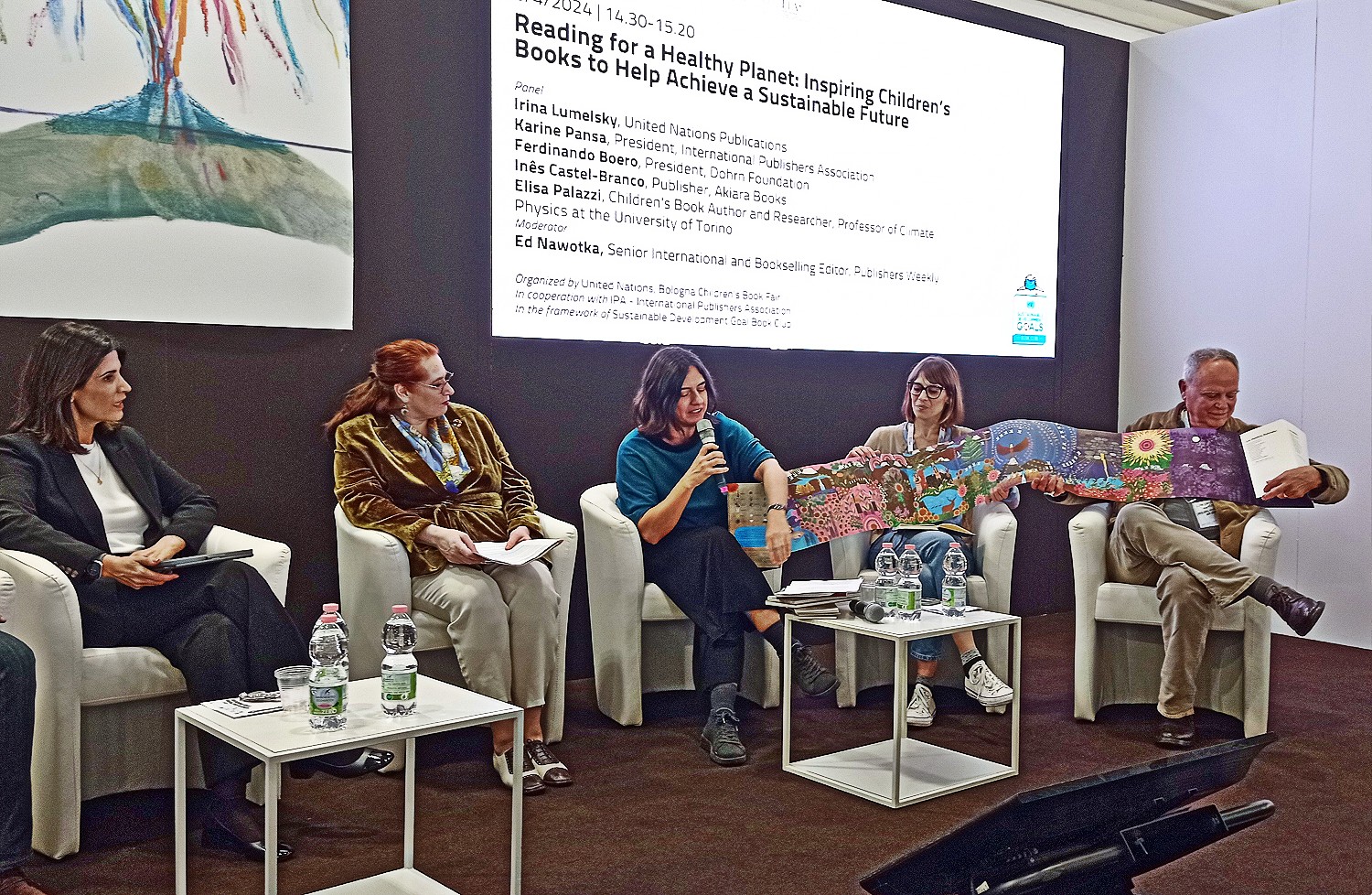
From left to right: IPA President Karine Pansa, Irina Lumelsky, UN Publications, Inès Casteò-Branco (with microphone), Publisher Akiara Books, Elisa Palazzi, author and Professor of Climate Physics, University of Torino, and Ferdinando Boero, President Dohrn Foundation   Source: Author photo

About next year’s Children’s Book Fair

The 62nd edition of the Bologna Children’s Book Fair is scheduled from March 31 to April 3 next year, with Estonia as the guest of honor. 

It will be interesting to see if the emerging trends at this book fair – a focus on more and better illustrations and graphic novels – will be confirmed next year. And whether some new ideas beyond romantasy will emerge.

Most importantly, it would be comforting to see publishers enlarging the concept of sustainability beyond environmental concerns and the fight against climate change to embrace social justice, equity, and more and better democracy.

Too many of the children’s books coming out these days are exclusively focused on climate change: on the E element (i.e. environment) of ESG, and not enough on S (social) and G (governance).

………………………………………………………………………………………………….

A shorter version of this article was first published on Impakter; click here to read it.

To read more of my articles published on Impakter, click this link:

https://impakter.com/author/claude-forthomme

Comments Off on Bologna Book Fair 2024: Looking For New Trends

Filed under art, book marketing, Business, Environment, Literature, Publishing

The Rich Don’t Pay Their Taxes Yet They are the Biggest Polluters

 Just published on Impakter:

Doctor Vijay Mallya’s personal aircraft. Kingfisher Airlines  Source: Michael Davis  CC BY-SA 2.0 

The Rich Don’t Pay Their Taxes Yet They Pollute The Most

by Claude Forthomme – Senior Editor

“The secret IRS files” is a trove of never-seen-before tax records showing how the 0.01%, billionaires like Warren Buffett, Bill Gates, Rupert Murdoch, and Mark Zuckerberg, actually get away with paying nearly no taxes. Just obtained from the US tax authorities by ProPublica, a non-profit newsroom that investigates the abuses of power, it is the first result of an ongoing investigation with assuredly more revelations to come. For the first time, we have indisputable evidence that the ultra-rich do not pay taxes that could be remotely considered as commensurate with their wealth or fair to the rest of the taxpayers. 

This is all the more shocking if you confront the ProPublica finding with a report from Oxfam, published in September last year, that showed how the lifestyle of the rich destroys the environment: The One Percent – just 63 million people out of the planet’s total 7.9 billion – are responsible for 15% of the carbon emissions.

Let’s take a closer look at the findings. In so doing, I think we’ll end up agreeing with what historian Rutger Bregman, the author of Utopia for Realists, told a room full of billionaires at the Davos World Economic Forum 2019, that they need to “step up and pay their fair share of taxes”:

See the video on Impakter, click here to read the article.

Comments Off on The Rich Don’t Pay Their Taxes Yet They are the Biggest Polluters

Filed under climate change, Environment, politics

A Serious Idea the G20 Should Consider: A Sustainable World Commission to Achieve the 17 SDGs

It took me weeks to develop the idea and many, many discussions with friends willing to listen to me and read all my various drafts. Here is the result, just published on Impakter:

A (Non) Modest Proposal for the G20: A Sustainable World Commission to Achieve the SDGs 

by Claude Forthomme – Senior Editor

The next G20 Summit Meeting of heads of state will be held in Rome on Oct. 30 and 31, 2021, under the Italian G20 Presidency. The agenda, with the title “People, Planet, Prosperity”, addresses major obstacles to achieving a sustainable world; a series of lower-level “working” meetings prepares the Summit, including, most recently: G20 Empower to identify measures to accelerate women’s empowerment; the Youth 20 Inception Meeting to open a two-month (virtual) dialogue for young delegates (between 20 and 30 years of age) to discuss global challenges; the G20 TechSprint Initiative under the sponsorship of the Bank for International Settlements (BIS) Innovation Hub and the Bank of Italy focusing on the most pressing challenges in green and sustainable finance.

With “People, Planet, and Prosperity” focused on achieving a sustainable world, the G-20 agenda is fully in line with the United Nations 2030 Agenda and the 17 Sustainable Development Goals (SDGs) that covers the whole gamut of sustainability issues from environment/climate change to social justice issues and economic development. The hope is that this G20 meeting will be powerful enough to move us toward a more sustainable world as defined by the SDGs – something we all seek, including advanced industrialized countries, according to the latest OECD paper calling for a “Green Transition”.

But how to get there? The time has come to decide not what should be done – the UN 2030 Agenda tells us that – but how to do it.

No doubt, there are many possible solutions, but here, I offer a (non) modest proposal. Not modest because it is very ambitious. But it has the advantage of being practical. And it is addressed to the G20 and everyone involved in the run-up to the upcoming Summit. 

Why the G20? Because today this is the one international organism most representative of the world’s geopolitical composition, as it includes both the most important leaders and the largest economies. 

The idea is simple and could be summarized in five points:

  • The goal of a sustainable world has been clearly spelled out in the UN 2030 Agenda and the 17 SDGs but the implementation – how to get there – has been left in the hands of national governments: 
  • No international organization as presently organized is equipped to carry through the necessary coordination to achieve the 17 SDGs; the UN cannot deliver, it has no coercive authority over its member states and in the hands of geopolitical powers;
  • A new governance system needs to be set up to achieve the 17 SDGs, an international institution able to coordinate national governments in a way that the United Nations system cannot: Strong, independent, and innovative, it could be modeled after a successful government agency such as NASA was after it was tasked by President Kennedy to take a man to the moon ;
  • Call it the Commission for a Sustainable World (CSW); while it could follow the NASA model, it would be mandated to achieve a far bigger task – namely, to make the world sustainable for eight billion people – and therefore require adequate funding and regulatory powers;  
  • The CSW must be independent like the European Commission is in its relations with EU member states; it would report on progress to the UN General Assembly and the G20, subject to review, say every 3-5 years, and limited in duration by a “sunset clause” to ensure that once the SDGs are achieved, the CSW would be terminated.

The key idea here is that the CSW is a hybrid institution, modeled after the European Commission but anchored in the UN systemyet much stronger than the UN. 

But it should not become a permanent new international organization or replace the UN.

Also, the CSW would pose no threat to national sovereignty as it would only operate in the areas agreed to by the UN General Assembly: UN 2030 Agenda and the SDGs. That means only two broad areas: The environment (which includes Climate Change) and social justice. And the CSW would regularly report to the UN and the G20 (should the G20 take it upon itself to promote and fund it) and be subject to review to ensure that management flexibility does not cause it to sink into corruption and that it remains within its mandate.

A note of caution: Some flexibility will be needed as the SDGs’ general timeframe is 2030 except for SDG13 (Climate Action) that includes the Paris Climate Agreement’s target to achieve zero-net emissions set at 2050. Also, problems evolve and unexpected events occur – for example, the COVID pandemic was barely mentioned under SDG#3. It would seem wise therefore to have the Commission established for at least 10-15 years. By going for even 10 years you have it running beyond the 2030 Agenda’s current life.

The goal is to give the new governance system a chance to show its worth and, if need be, adapt it to new circumstances. Here is what it would take to create such an institution. And it starts with our changing view of the role of government.

Sounds like a good idea? Interested in finding out more about the Sustainable World Commission? Click here to read the rest.

Comments Off on A Serious Idea the G20 Should Consider: A Sustainable World Commission to Achieve the 17 SDGs

Filed under climate change, Economics, Environment, European Union, politics, Uncategorized

The U.S. and Europe Announced New Climate Goals: Will They Be Enough?

We keep hearing about wonderful new goals for fighting climate change, but will they be enough to save us from the worst effects of global warming? The numbers, by themselves, mean little. What matters is what is behind them: Investment in “green” innovative projects and a government’s environmental regulatory framework. I explored the issue in the following article for Impakter, here is the opening:

Can the New US and EU Climate Goals Save the World?

by Claude Forthomme – Senior Editor

Last week in April was marked by the announcement of new, more ambitious climate goals from two of the world’s largest polluters, the United States and Europe. Could they be a turning point in the fight against climate change? The question really is: Are the new climate goals going to be game-changers? Or are they just so much powder in the eyes of the beholders?

On 21 April, the European Parliament and Council reached an informal agreement to raise the EU’s 2030 emissions reduction target to at least 55% below 1990 levels, compared with the previous 40% goal. And on 22-23 April, the U.S. announced its own ambitious goal of cutting its 2030 emissions by half. This announcement, given at the Leaders Summit on Climate convened by President Biden, was viewed by everyone as a major attempt by the U.S. to reclaim climate leadership.

Read the article on Impakter, click here: https://impakter.com/new-us-eu-climate-goals-save-world/

Let me know what you think.

Comments Off on The U.S. and Europe Announced New Climate Goals: Will They Be Enough?

Filed under Business, climate change, Environment, European Union, politics

They are ALL lying to you: The world’s top brands are NOT going green

 This is one major article, published on Impakter, that I don’t want you, my dear readers, to miss:

For the World’s Top 100 Brands, Sustainability Is Elusive Despite Claims

by Claude Forthomme – Senior Editor

For the 2020 Top 100 Global Brands, a list derived from Forbes World’s Most Valuable Brands, the goal of sustainability continues to be out of reach, despite their many claims to the contrary. This is what the findings of a three-month analysis carried out by the Impakter Index team has just revealed (results published on 18 December 2020). 

The conclusion is clear: Most companies have a long way to go before they achieve full sustainability in line with the UN Sustainable Development Goals and targets pertaining to their area of activity – if ever. 

A high level of “greenwashing” is still prevalent among major household names. Some of them haven’t even started on the road to sustainability, others can never make it because of the very nature of their activities (based on/using fossil fuels or dangerous chemicals). Most are doing an average job though they claim otherwise, and none is one-hundred-percent sustainable. Not one. 

I know that many of my readers who’ve read my article when the Index was launched this summer (31 July), or saw Common Place editor, Quincy Childs’ endorsement, will want to go directly to the Impakter Index and check out their favorite brand (go to the Impakter home page or click here to see). You may well be surprised (or perhaps not) to find that in most cases, there is a stunning gap between what companies claim and what they actually deliver in terms of sustainability and social responsibility. 

Look at the findings, the table provides a summary view of the ratings obtained by the top 100 brands:

To find out how they are rated by the Impakter Index, go to my article, click here.

I promise you, you’ll be surprised (I know I was)!

Comments Off on They are ALL lying to you: The world’s top brands are NOT going green

Filed under Business, climate change, Economics, Environment, politics, Sociology

The World After COVID: Back to Capitalism as We Know it or Something New?

 Last week I reviewed two amazing books that propose a new world after COVID, doing away with capitalism as we know it but using radically different means to achieve this goal. Both my reviews were published on Impakter. Here’s the opening of my article:

Post-COVID: Blueprints to End Capitalism As We Know It

Capitalism as we know it is morphing into an “awful kind of techno feudalism” that only deserves to die, says Yanis Varoufakis. A radical statement but coming from the former finance minister of Greece who famously battled the European Troika for the Greek cause at the height of the debt crisis in 2015, it is no surprise.

Can activists in their battle against shareholder capitalism use financial engineering to bring Wall Street to its knees? That is the scenario Varoufakis proposes in his latest book Another Now: Dispatches from an Alternative Present (published in September 2020 by Vintage), arguing that finance is the Achilles heel of capitalism.  And here’s the other must-read book I reviewed:

How To Reform Capitalism – Mariana Mazzucato’s Moonshots

The Trojan horse comes from another economist, an Italo-American, a woman, Mariana Mazzucato who has already shaken up the academic world of economics with her bestselling The Entrepreneurial State, published in 2015 with the subtitle: “Debunking Public vs. Private Sector Myths”. 

Her solution for post-Covid reconstruction? Work from inside the system

Give back to the state the role it played back in the 1960s when America, engaged in a space race with the Soviet Union, unleashed the power of the Federal Government.

She lays it out in her new book, just out, January 28, 2021: Mission Economy: A Moonshot Guide to Changing Capitalism (published by Penguin).

Mazzucato is Professor in the Economics of Innovation and Public Value at University College London (UCL) where she is also Founder and Director of the Institute for Innovation and Public Purpose. And her ideas have already been adopted both by the European Commission and the Scottish government. 

Both are highly recommended reads! Curious? Take a look at my article, click here.

Comments Off on The World After COVID: Back to Capitalism as We Know it or Something New?

Filed under Book review, climate change, Digital Revolution, Economics, Environment, non-fiction, politics, Sociology

There is no Time to Lose: Climate Change is More than an Emergency

 My latest article on Impakter:

The World Needs to Wake Up: At Risk the Survival of Humanity

At a time when the world, battered by COVID-19, is watching with dismay the rocky transition from Trump to President-Elect Biden, a group of 17 world scientists reminds us that maybe all our worries are futile. What is at risk is something far more important: The very survival of humanity. The prognosis is dire and it comes in a just-released major perspective paper: “Underestimating the challenges of avoiding a ghastly future” published in Frontiers in Conservation Science. 

On the basis of a comprehensive yet concise assessment of the state of our civilization, these scientists – experts from major institutions including Stanford University, UCLA, and Flinders University – are telling us in no uncertain terms that the very survival of all species, ours included, is threatened. 

And that the outlook is far more dire and dangerous than is generally understood.

The causes are well known: A loss of biodiversity and accelerating climate change in the coming decades coupled with ignorance regarding the state of our environment and political inaction across the planet. 

In the researchers’ view, world leaders need a ‘cold shower’ to come to their senses and plan and act in time to avoid a “ghastly future”. Professor Paul Ehrlich of Stanford University noted that no political or economic system, or leadership, is prepared to handle the predicted disasters, or even capable of such action:

“Stopping biodiversity loss is nowhere close to the top of any country’s priorities, trailing far behind other concerns such as employment, healthcare, economic growth, or currency stability.

While it is positive news that President-elect Biden intends to reengage the US in the Paris Climate accord within his first 100 days of office, it is a minuscule gesture given the scale of the challenge.

Humanity is running an ecological Ponzi scheme in which society robs nature and future generations to pay for short-term economic enhancement today”.

A year ago, Paul Ehrlich was adamant that our civilization is about to collapse

Read the rest on Impakter, click here. Share the news, let me know what you think.

Comments Off on There is no Time to Lose: Climate Change is More than an Emergency

Filed under Environment, politics

Latest article: Saving the Skyros Horse – Interview with project founder

Just published in Impakter Magazine, this long read for the weekend. I had a great time talking to Aliki Steen, the founder of the project to save this ancient horse from extinction! Here is the beginning:

In the past fifty years, humans have managed to destroy 60 percent of animal populations. Among them, one is of historic importance: The ancient Skyros horse, whose ancestors are said to adorn the Parthenon frieze. At the start of the 21st century, some 200 animals were reportedly left, of which only 90 could be considered genetically pure. Such a low number suggested that the horse could be facing a fatal lack in genetic variability leading to its extinction.

But the Skyros horse has found champions ready to save it. Among them, Professor Nikos Kostaras, President of AMALTHEIA, (a non-profit organization for the protection of native Greek farm animals and rare Greek livestock breeds threatened with extinction). He has worked with an American expert on horse genetics, Professor E. Gus Cothran, of the Texas A&M University’s Animal Genetics Lab, when the latter came to Greece to carry out a genetic study of the Skyros horse. Subsequently published in 2011, the study proved that the Skyros pony is “outstanding through having a distinct phenotype” and was found to be “isolated, without any relationship to any horse breed” in Greece or in the region.

I talked to Professor Kostaras about the future of this horse and this is what I learned.

Describing the Skyros horse as “one of the gems of the equine family”, he noted that it was perfectly adapted to its environment, “the result of isolation in an insular environment with poor vegetation and harsh climatic conditions.” The historical data, however, supported the idea that the Skyros horse is part of a large family of horses that lived in most Aegean islands, and for thousands of years, were “serving humans in their day to day activities.”

The problems arrived with the mechanization of agriculture that caused a steep population decline, and, he said, even extinction of some Aegean horse populations. Among the threatened species, we have the Skyros horse, the Rodos small horse (with a total population of 12 horses), and the ‘Mintili’ the small horse from the Island of Lesvos, thought to be extinct from the 1960s and rediscovered in 2017 in a feral state.  

However attempts to preserve the Skyros horse were, he said, “short-sighted and had devastating effects.” In particular, there were two “major bottlenecks” resulting in the loss of precious genetic variability. The loss of genetic variability, he pointed out, is “a major threat to the survival of the breed.”

The creation of the “Skyrian Horse Society” in 2006 was a first step in the right direction.  The society kept a studbook, recording all the Skyros horses that live on Skyros island, the rest of Greece and abroad, thus setting the breed standard.

He described how the Skyrian Horse Society has set out to overcome the loss of genetic variability problem, focusing its strategy on increasing the population size without risking further loss of variability.  For this, he explained, all horses have been DNA tested and each horse’s inbreeding coefficient established. This enables the development of optimum out-crossing plans and thus the long-term survival of the breed.

Today the population of the breed, he reported, has increased to approximately 400, of which 160 exhibit all phenotypic characteristics of the breed. Another study is presently underway to assess the current status of the breed.

Among those leading this conservation action, he said, was and still is The Silva Project in Corfu and the Katsarelias Simpson project in Skyros.

Armed with this information and the good news that the Skyros horse population has practically doubled from where it was a couple of decades ago, I set out to interview Aliki Steen who is a founder and working on The Silva Project in Corfu and Athens, one of the two leading conservation programs mentioned by the professor.

I discovered that the SILVA breeding program started in 1996 with four horses, two stallions and two mares. The horses were originally brought to Corfu because they required living and breeding free and in a semi-wild environment which was provided at Villa Silva, an olive grove near Corfu town owned by Aliki Steen’s family.

Over time, the total number reached 45 purebred horses, although there are fewer now in Corfu because The SILVA Project “helped” other breeding centers in Greece and abroad (e.g. in Peebles, Scotland): The horses were “given away”, not sold, in order to create additional breeding centers.

From the start, the program was and is engaged in advocacy to make the public – and also potential breeders – sensitive to its cause.

The program is also engaged in equine therapy, with the special needs of about 30 children attended to every year. In relation to this, a Silvaland Riding Center has been established with both therapeutic and classical riding programs. In addition to the usual riding facilities, there is a café, and the Center organizes a variety of activities, including dog shows and horse riding competitions. It also offers an internship program and runs a 20-acre organic kiwi farm. A rare Greek breeds Educational and Environmental Park based at Silvaland is under development intended for school children and tourists.

I had a long talk with Aliki Steen who joined her family’s project from the start (1996) in parallel with her work in finance. Born in Athens, Greece, from a Greek mother and a Norwegian father, she came to Brussels in 1983 for her studies, then worked for several years in finance, her latest position being director of global internal communication for a large international banking group.

Aliki Steen with one of her Skyros horses

How are your horses today, any recently-born foal or happy event on the way?

Aliki Steen: The Skyros horses on Corfu island are living in a little earthly paradise, called Villa Silva, in Kanoni near Corfu town. Our current “working” horses, that is the small horses used for riding for children and therapeutic riding for people with special needs, are kept on other premises, near the village of Kalafationes, in the center of the island. This riding ranch is called Silvaland and it is better suited for riding during the rainy winter days or during the very hot summer period. 

For the moment, we do not have any pregnant mares on the property – ideally, each mare should be pregnant only once every five years. The older Skyros horses are all in great shape and, as some of you may know, they also live much longer than other “modern” horses – 40 years or so if they get good food and appropriate veterinary care.

That is a remarkably long life span! Can you tell us how the island of Corfu was affected by the coronavirus pandemic? 

A.S.: Most coronavirus cases in Greece were observed in Athens, Patras, and the Northern part of Greece. All islands, Corfu included, were preserved, mainly because the Greek government took very strict confinement measures from the very beginning. Experts say that both the stringency of those measures and the way Greeks have largely abided by them, have been key to Greece avoiding the worst ravages of the global pandemic.

As of Monday 25 May 2020, the internal borders have finally opened and it is possible to travel anywhere in Greece. As from June-July, tourists will certainly travel to the Greek islands, but everyone hopes that the relevant social-distancing measures will help contain a potential second coronavirus wave.

How did Greece manage to cope so well with the pandemic?

A.S.: The coronavirus outbreak in Greece should have been a disaster. As a popular tourist destination, Greece received 27 million visitors in 2019 alone—presenting a potentially significant risk of COVID-19 from international travelers. The country’s population is the second-oldest in the E.U. (behind only Italy), its health sector has been ravaged by austerity, and its crippled economy is still nearly 40% smaller than it was in 2008, before the last global financial crisis.

Officials said in 2019 that, after three bailouts and drastic cuts to its public healthcare system due to austerity, there were only 560 ICU beds in the entire country of 11 million – that is 5.2 beds per 100,000 people, compared to Germany’s 29.2. The conclusion is clear: Full application and respect for quarantine measures made the difference.

Let me turn now to your project, saving the Skyros horse from extinction. Can you tell us how The SILVA Project was born?

A.S.: In 1995, my Greek family and I discovered that the ‘Skyros small horse’, an ancient Hellenic breed, was endangered and on the verge of extinction. Since this horse doesn’t live in captivity or in stables, it was imperative that a large property was found, adapted, and used for its breeding. With very little knowledge about horses in general, we started breeding in extremis the very last purebred horses that remained in Greece. This is how in 1996 The SILVA Project was born in Corfu, Greece.

What were the challenges you confronted?

Read the rest of the interview on Impakter, click here

———————————————————————————————————————–

In the featured photo: Parthenon Frieze, detail. Note the size of the riders in relation to the horse – long thought that the enlargement of humans was a way to indicate their elevated status, it is now believed that this is an exact representation and that they were, in fact, riding small horses – i.e. the Skyros horse. Source: Urban Grammar

Comments Off on Latest article: Saving the Skyros Horse – Interview with project founder

Filed under Environment, philanthropy, travel

What Sustainable Finance Means and What it Can Do

Just published my latest article on Impakter magazine, here’s the opening:

SUSTAINABLE FINANCE: HOW TO ADDRESS NATURE RISKS AND CLIMATE CHANGE

As our environment is undergoing ever faster collapse, with the rainforest burning in the Amazon, the ice melting in the Arctic and now California ravaged by fires, the goal of achieving sustainable finance appears ever more elusive. It is obvious that nature risks directly translate into financial risks. And with climate change accelerating, it is equally obvious that growing natural risks is the cause of equally growing financial instability.

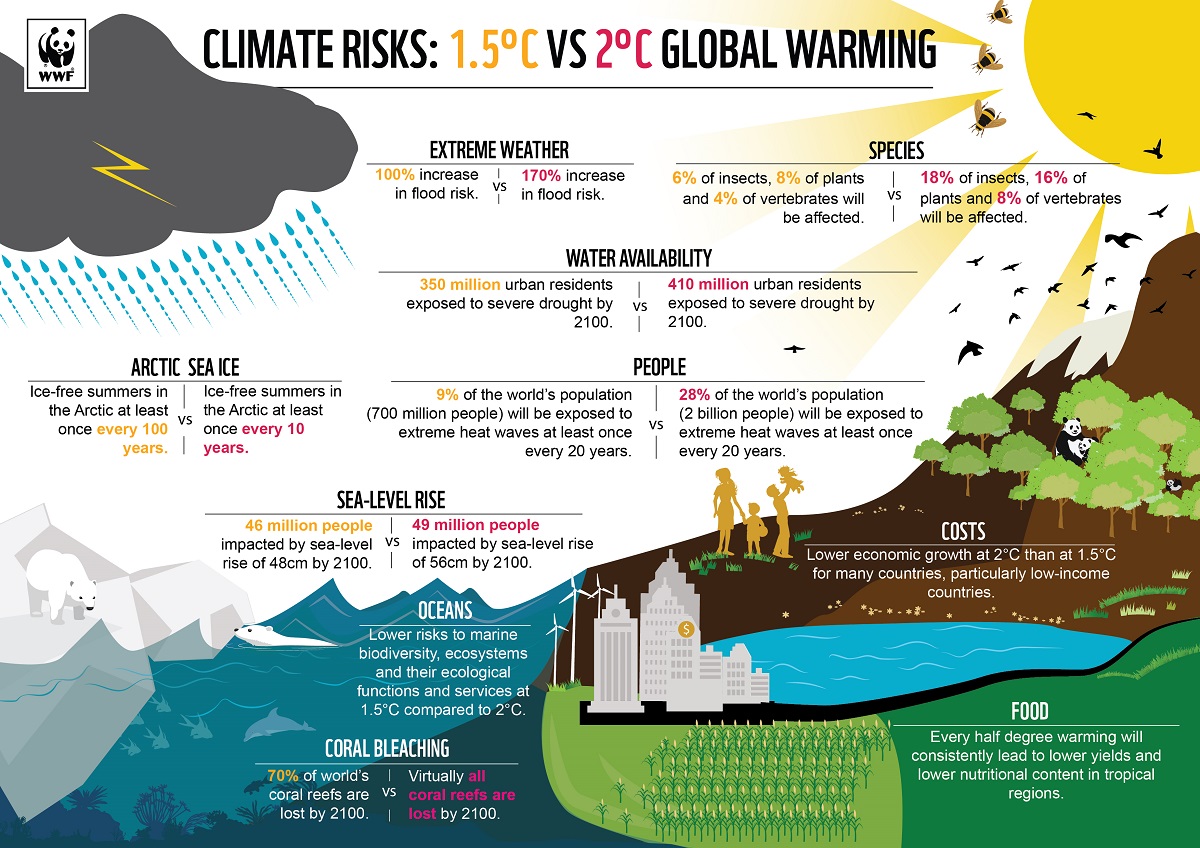
While the relation between nature, climate and sustainable finance is obvious, the exact impact is not so clear. Natural disasters, from floods to air pollution events to wildlife species extinction, can impact businesses and whole economic sectors in variable ways, some more than others. And a small further rise in global warming, as small as a half degree centigrade, can make a stunningly huge difference:

To illustrate with the famous case of a highly valuable wildlife species threatened by extinction, i.e. bees whose pollination activities are fundamental for agricultural production. A prosperous European pharmaceutical company suddenly faced catastrophic financial losses after it had acquired in 2018 an agrochemical company accused of causing adverse impacts on bee populations that led to a series of health-related trials. Suddenly, it lost almost 40% of its market capitalization in less than one year, causing shareholders billions in losses.

To put a name on these firms: the pharmaceutical company is Bayer, the agrochemical is Monsanto and the cause of the bee-killing is, of course, a pesticide, the infamous “Roundup”. In short, Bayer is worth less today than the $63 billion it paid for Monsanto about a year ago.

As a first step to ascertain what the effects of nature risks are on the finance industry, a number of academics at the University of Hamburg have formed a Research Group on Sustainable Finance and analysed for the first time the existing academic literature which highlighted the relationship between nature risks and financial risks. The study has been financed by WWF Switzerland and will be uploaded to their website this month.

They identified 154 peer-reviewed articles published between 1966 and 2019. These articles covered four areas: banking, insurance, real estate, and stock markets; and nine nature risks: disease, drought, erosion, flooding, invasive species, oil spills, pollution/environmental contamination – of air, groundwater, soil/land and surface water -, solid waste, and bushfires.

“Destruction of ecosystems results in financial risks”

Overall, the articles confirmed that the destruction of ecosystems results in financial risks. They also found that nature risks are not adequately reflected in current risk models of financial institutions and therefore not priced correctly.

Incorrect pricing is a major concern. It means that financial institutions urgently need to identify how the activities they finance impact the natural world. Developing a framework for investors to analyse nature risks and integrating these systematically in their valuation models is crucial. It would be the first indispensable step to achieve sustainable finance.

What is interesting is how the literature reviewed by the Research Group on Sustainable Finance identified variable impacts depending on the sector and the kind of nature risk. The sector that tends to suffer the most from nature risks is real estate. The greatest threats to valuation in the real estate sector include flooding followed by air pollution (and environmental contamination in general) and bushfires.

That of course, is a massive financial problem – but it is a problem for individual property owners too. The house you just bought, or that you inherited from your parents, could be worth next to nothing in just a few short years.

To find out how other sectors in the economy will be impacted and what should be done, read the rest on Impakter, click here: https://impakter.com/sustainable-finance-address-nature-risks-climate-change/ 

Comments Off on What Sustainable Finance Means and What it Can Do

Filed under Business, climate change, Economics, Environment, politics

Funding: Too Much for Notre Dame in Paris, Not Enough to Fight Climate Change?

My latest article on Impakter:

Notre Dame burning in Paris, 15 April 2019 Source: Wikimedia

Soon after Notre Dame in Paris went up in flames, teenage climate campaigner Greta Thunberg, in a speech to the European Parliament, said she did not want to diminish the Notre-Dame fire, but wished there was an equal outpouring of funding support to combat issues such as climate change.

The outpouring of funding to rebuild Notre Dame was indeed impressive. Within 24 hours of the blaze, French luxury tycoons had pledged donations in the hundreds of million Euros: François-Henri Pinault (Kering) came through with €100 million; his crosstown rival Bernard Arnault (LVMH) with  €200 million; the Meyer Bettencourt family (Oreal) with €200 million.

Add to that the €100 million announced by Total CEO Patrick Pouyanné

Is Greta Thunberg right? Is there not enough to fight climate change? I thought I’d investigate the question and if you’re curious and want to get the answer, read the rest of my article on Impakter, click here

Let me know what you think!

Comments Off on Funding: Too Much for Notre Dame in Paris, Not Enough to Fight Climate Change?

Filed under art, climate change, Environment, philanthropy, politics