Category Archives: non-fiction

What’s Wrong with Europe? Ukraine, Greece and Libya: All Unfinished Businesses

Libya is sinking into a fundamentalist Islamic chaos, the cease-fire in Ukraine is breaking down and Greece’s debt problems are far from resolved.

Merkel, Putin and Hollande at the Kremlin (2015)

And this in spite of the the so-called agreement reached in Minsk between Putin and the Merkel-Hollande couple. And in spite of the news coming out late Friday evening (20 February) that the Eurogroup (the Euro-zone 19 finance ministers) had agreed to extend by four months Greece’s bailout, thus avoiding a financial shutdown of Greece.

Anyone following the news in Ukraine can see that the cease-fire hasn’t got a ghost of chance, with Russia still fully supporting the rebels’ advance in the East.  Yet, both Hollande and Merkel confidently talk about taking new sanctions and Kerry echoes them. One wonders how anyone can still believe in the power of sanctions. Surely Putin doesn’t care.

As to the Greek bailout extension, it’s a sham: this coming Monday (23 February), as reported in the New York Times:

“Greece must send its creditors a list of all the policy measures it plans to take over the next four months. If the measures are acceptable, European finance ministers could sign off on an extension of the bailout agreement on Tuesday.”

Varoufakis and Tsipras (Facebook)

Really, a “list of all the policy measures” by Tuesday? And to whom are the said measures supposed to be “acceptable”?

To Germany, of course. The fundamental idea is that a newly elected government in the Euro-zone cannot change the commitments taken by a previous government, i.e. the austerity measures forced upon Greece by Germany. Therefore the new government led by Tsipras and his dynamic finance minister Varoufakis must continue with the reforms and austerity policies called upon by the infamous “troika”, the European Union, the European Central Bank and the International Monetary Fund.

Back to square one.

Italian Military Mission (Olycon)

And the same can be said for Libya. The chaos threatening this country, just 350 km off the coasts of Europe, is a matter of grave concern to Italy: the radical fundamentalist Islamic militia over-running Libya are patterned on ISIS. Threats have already been sent via Twitter to Italy. The wonder is that the rest of Europe doesn’t seem to care. Italy declared its willingness to lead a multinational force to “restore peace and order” in Libya and sought a green light from the UN Security Council – as did Egypt, after it had attacked extremist positions inside Libya a few days ago.

But the Security Council did not respond – in practice, both Egypt and Italy were told to calm down and forget it.

I am worried. The world is fast sinking into anarchy, the West is doing nothing to stop it and not even using its prime instrument to prevent war: the United Nations. After Gaddafi was ousted, no serious effort has been undertaken to help Libya recover and rebuild – a tiny UN mission was sent to Libya, with no means to operate on the ground, and all the UN Representative can do, is warn that Libya is falling apart. Yes, it’s rapidly becoming a failed state like Somalia, and it’s sitting on Europe’s doorstep.

Of the three problems, Greece should be the easiest to fix: write off the debt and forget it. If one is to believe Paul B. Kazarian, one of the “vulture investors” of Hilary Rosenberg’s famous book, the €318 billion Greek debt is worth only one tenth of its value as a result of the series of adjustments to the Greek debt over the years that include restructuring, maturity extensions and interest rate reduction. He argues that if one applied international accounting rules and took into account the assets owned by Greece, the overall net debt figure would fall to €32 billion. “You are suffocating a country with a figure that has no relevance”, he argues, “Just take the fricking loss and move one.”

Not many people agree with him, such views are always scary to conservatives and particularly so in German circles. Yet, historically, sovereign state debts have always been treated this way: that is exactly what happened in the United States, for example when the Second Bank of the United States collapsed in 1836, sending thousands of UK investors scrambling for their money. This was not the end of the United States’ dollar, so why should a Greek (near) default be the end of the Euro?

When will our European leaders wake up and start facing the far more important challenges of Ukraine and Libya? Europe, quo vadis, where are your values, where are you going?

Comments Off on What’s Wrong with Europe? Ukraine, Greece and Libya: All Unfinished Businesses

Filed under non-fiction, politics

Climate Change and the Collapse of Western Civilization

To anyone living in Europe, it is truly puzzling that Americans continue to deny Climate Change.  The anger, recklessness and vehemence displayed by American “climate deniers” are something of a mystery. And their favorite argument is that there is no scientific “evidence” of global warming – in spite of the rising number of “extreme” weather events, the floods, the fires and the melting ice, and some of it happening right on their doorstep.

Now, finally, two American scientists – one from Harvard, the other from the California Institute of Technology – have given us the key to the mystery.  Naomi Oreskes who is professor of the history of science and affiliated professor of Earth and planetary sciences at Harvard University and Erisk M. Conway,  an award-winning historian of science and technology at the California Institute of Technology, have used in their latest book, The Collapse of Western Civilization, a remarkably effective dramatic device. Instead of writing a standard analysis, they have set it in the future, giving it the detached, objective tone of scholarly work. It is intended as the fruit of research by a future scientist looking back on our time and trying to figure out the factors that “explain” how global warming caused the collapse of Western civilization. The year is 2939, and what bothers our future scientist is how the United States, the most powerful country on Earth, was, in spite of its power, unable to reverse climate trends.

Don’t be put off by the dramatic subject. This is a book packed with humour that will make you smile (or perhaps snigger?) and the book description in the Kindle Store perfectly captures the spirit of it:

 “a senior scholar of the Second People’s Republic of China presents a gripping and deeply disturbing account of how the children of the Enlightenment, the political and economic elites of the so-called advanced industrial societies, entered into a Penumbral period in the early decades of the twenty-first century, a time when sound science and rational discourse about global change were prohibited and clear warnings of climate catastrophe were ignored. What ensues when soaring temperatures, rising sea levels, drought, and mass migrations disrupt the global governmental and economic regimes? The Great Collapse of 2093.”

The book is clearly a success on Amazon. This is the ranking (as of February 1, 2015):

And it has already garnered 178 Amazon customer reviews. On Goodreads it got 305 rankings (average 4 stars) and 91 reviews. The mainstream media also paid attention to it, in Nature, Scientific American, the New York Times and probably many more that I missed.I particularly liked this comment from Elizabeth Kolbert, the author whose The Sixth Extinction: An Unnatural History I’ve reviewed in an earlier post. This is what she has to say: “Provocative and grimly fascinating, The Collapse of Western Civilization offers a glimpse into a future that, with farsighted leadership, still might be avoided. It should be required reading for anyone who works — or hopes to — in Washington.”

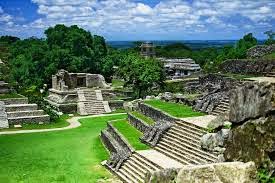
Yes, can we sway our politicians  or are we destined to perish like the Maya civilization? A few decades of drought, causing an economic collapse and internecine fights, were enough to turn the once-splendid Maya cities into ghost towns by the time the Spanish conquered Mexico. Of course, our civilization is global and it will take much more than a few decades of drought to kill it off. But then, Climate Change is a much more massive event…

Maya site: Palenque

I was so moved by this read that I wrote a review (now on Amazon) that I’m happy to share here:

5.0 out of 5 stars A Powerful Read and a Wake-up Call, January 20, 2015
Delightful read if one may be allowed to use that particular adjective when the subject is so grim. And the authors, two science historians coming from the best universities in America (Harvard and the California Institute of Technology), managed the feat of making serious analysis read like fiction. A real page-turner. Yet it’s not fiction, far from it. The book is in fact reviewing what’s wrong with our society, pin-pointing with deadly accuracy the reasons why we are unable to stop our “civilization” from rushing to “collapse”. This is a book that should be taken seriously by anyone concerned with our future, and in particular by our political leaders.

The idea of analyzing what is happening in the climate change debate from the standpoint of the future (the book is purportedly written by a future historian located in China in 2393) is particularly effective as it gives a neutral, balanced voice to the whole account. And it is refreshingly novel. The fact that it is short (a mere 100 pages) no doubt also helps. This is both a powerful read and a wake-up call. I found the arguments particularly convincing and being an economist, I especially liked the twist they put on economic concepts, for example, Hayek’s and Milton’s “neo-liberalism” calling it “market fundamentalism” (indeed, those theories are ideologies rather than scientific) or “gross national product” amusingly described as an “archaic” concept.

The humor is there but it is ultimately very dark humor. The message is clear. If we don’t do anything, if we don’t reverse engine and control gas emissions, we are doomed and why this is so is masterfully demonstrated. Many factors are at play and the authors pull them together in a compelling way, using the detached tone of a future historian who is puzzled by the fact that Western Civilization could not avoid collapse in spite of its remakable advances in science and technology.

The reasons for our failure to address climate change are clearly analyzed and deconstructed – and suddenly, reading this brilliant essay, I began to feel like the Mayas must have felt when decades of unexpected drought destroyed their civilization, causing economic collapse, local wars and social chaos. Just like in the case of the Mayas, the reasons we are failing are all linked to each other – to global warming of course, but more importantly, to the way we handle it (or rather do not handle it – we simply deny it’s there).

The book is at its best in explaining exactly why we deny climate change, in pointing to the “internal” causes, things that lay at the heart of our civilization, things that made it once great and that are now causing its fall – like, for example, “reductionism” which is the idea (that began in Descartes’ time) of solving large problems by breaking them down into smaller, more “tractable” elements. The approach has proved powerful to advance knowledge but as the narrator coldly remarks “reductionism also made it difficult for scientists to articulate the threat posed by climate change, since many experts did not actually know very much about aspects of the problem beyond their expertise.” As a result, scientists did not speak in a single voice, climate change continued to be denied, fueled by the interests of the “carbon-combustion complex” – another witty take on Eisenhower’s famous “military and industrial complex” – and political leaders thought they had more time to address it than they really had.

Other contributing factors are also identified, such as over-reliance of scientists on the concept of statistical significance (also termed an “archaic”!) – something that had never occurred to me before and yet totally makes sense. And this is yet another reason why I loved this book: the authors managed to shed new light and come with new insights on an argument, climate change, that I tend to consider “closed”, in the sense that I can’t imagine what more could be added.

Actually, although I gave it 5 stars, I don’t think the book is perfect. It falls in two areas, as I point out here:

There are only two aspects I regret, one, is the reference to just one climate fiction novelist (there are many, climate fiction is a brand new genre and rapidly rising with the likes of Margaret Atwood) but of course, the authors have a right to their own likes and dislikes in fiction; the other, is the premature burial of the United Nations following the collapse of international talks on climate change at some point in the mid-21st century. Personally, I view such a collapse totally unlikely – the United Nations are here to stay, they are indispensable and most likely to preside over the collapse of our civilization rather than being buried before…But those are minor details and don’t detract from the main strengths of this excellent book, which is to unravel the puzzle of climate denial.

Highly recommended.

Yes, regarding the United Nations, I do think the authors got it wrong. The road is long and difficult, but the United Nations could well be the one institution that will help to wake up the world to the danger and save Western Civilization from collapse! But I do take it on board that the authors were writing a worse case scenario and therefore had to somehow delete the UN from the equation.

As to the idea that we will experience Global Collapse as soon as 2093, why not? I suspect it is a little early, but I could be wrong on that one. In any case, in my own book about the future (Gateway to Forever), the story starts in 2222 and global warming is not longer a subject of debate, it’s a fact. Why did I chose that date? Because I rather like the numbers that repeat themselves (!). And I didn’t want to fall in the error Orwell made with his 1984 which was far too close to his publishing date (1948)… But then, he too liked to play with numbers and simply reversed them!

Naomi Oreskes rock climbin at Jackson Hole 2011 (photo Andy Tankersley)

Comments Off on Climate Change and the Collapse of Western Civilization

Filed under Cli Fi, Literature, non-fiction, science fiction

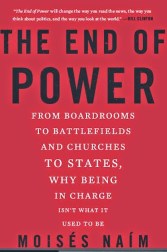
“The End of Power”, Mark Zuckerberg’s Choice

Why would the world’s most famous billionnaire, Mark Zuckerberg, pick Moises Naim’s erudite book, The End of Power, as his bedtime reading in January – and at the same time create a book club on Facebook that drew 250,000 members over just two weeks?The first answer is: wow! 250,000 in 2 weeks is surely a sign of power. Publishers (and authors) take note.

The second is a little more complex. As the UK Guardian commented, the ‘year in books’ kicked off with Mark Z.’s announcement that he would read one book every other week in 2015 and everyone rushed to buy the first book he chose to read, Naim’s latest opera magna.  The effect was instantaneous: the book flew to the top of best-selling non-fiction on Amazon – I checked today, it’s #1 in both “international and world politics” (hey, what’s the difference between these two terms?) and “History & Theory” (never knew there was such a thing, does it mean the theory of History or the history of Theory?). No matter.  The point is that Mark Z.’s choice sent it climbing off the high shelf (over 40,000th rank on Amazon) where it had been sitting quietly since it was published back in 2013. However, it should be noted that it had never been quite forgotten all this time: it had been enough of a success in academia and among the likes of Bill Clinton to be republished in March 2014. No doubt one reason why Mark Z. picked it.

But journalists won’t let go of Mark Z. It was noted (again in the Guardian) that the reason for this choice no doubt had something to do with the fact that in his own way Mark Z., as the founder of Facebook, is one of the most powerful men in the world. And with a title like that, the “End of Power”, Mark Z. would obviously be interested. Who wouldn’t want to find out what kind of dangers to your hegemonous position the future might hold?

Incidentally, and this is directed to my fellow writers, please note that a tech billionnaire who makes time to read books in his (presumably) super-heavy schedule does NOT pick as his first read a fiction book. No, sorry guys, he does not. No thriller, no romance, not even a historical. And this is something that really doesn’t surprise me: in my experience, people who work hard do not read fiction, at most they might read history books or biographies of famous people. And of course futurology-type books like Naim’s – books that ask hard questions about the world we live in. But not fiction – for such people, fiction is not entertainment, it’s a waste of time…And this applies to men and women alike – I remember that when I worked, I rarely read fiction except when I traveled and I suspect this is still the case today for career women.
Back to Mark Z. and his book club adventure. How did that first two weeks of reading go? First, he organized a Q and A session with the author, inviting his 31 million followers. As reported by the Washington Post (here) it was off to a “pretty lame start” and the UK Guardian (here) noted it was a “disappointing first chapter”. Fewer people turned up than expected, I checked, a little over a thousand out of the 250,000 who had signed up for the Book Club. And the stream of questions and answers were jumbled, missing parts and almost illegible – not a pleasant read.

Several journalists quicked noted that Mark Z. had been tripped up by his own algorithms on Facebook that nowadays (for reasons only known to FB programmers) mysteriously hide certain posts – and that many of the Book Club members probably had not even noticed the invitation to the Q and A session in their news stream. And many of those who did come obviously hadn’t read the book, as  shown by the 137 questions asked. Also, several people, rather than asking questions to the author, wanted the book free and/or complained of difficulties to download the book on their Kindle etc. Actually, when I went yesterday to the book page on Amazon to write my own review of the book, I noticed that hitches with the Kindle had even wound their way into an absurd 5-star review of the book – not a review of the book at all but a complaint regarding downloading (hence, why give it 5 stars?). Surprisingly (or perhaps not so surprisingly), Amazon did not take it down even though it is blatantly not a review.

The Washington Post suggests why so many people might not have read  the book by the time of  the Q and A session:

“It isn’t exactly a sexy beach read. (From boardrooms to battlefields and churches to states, being in charge isn’t what it used to be”!) It’s also 320 pages long, which means — since the club starts a new volume every two weeks — you’d have to read 23 pages each day to keep up.”

Yet in spite of all this hullaballoo around the book, it is, in my opinion (and I read it!) really worth the effort. Here is my review, as posted on Amazon:

An Excellent Read – A Misleading Title   (4 stars out of 5)

Engaging, fast-paced and chock-full of information, it is a great read, hard to put down. The approach to analyzing power is novel and the premise on which the whole book is built is compelling, as many other reviewers have noted here, in particular, the three “Ms” – More, Mobility and Mentality – as analytical tools. The book argues that the nature of power today has changed; “minipowers” have arisen thanks to globalization and technological advances, in particular the digital revolution and Internet, and they are now able to successfully fight back the “megapowers” (read: nation-states; big churches and religious organizations; big, transnational corporations, trade unions etc). And the author provides vivid examples to illustrate what he means, well-chosen and convincing.

The trouble starts midway through the book when the time comes for the author to show that there is actually a trend towards decaying power. Naim fails to show that trend and the data he brings only shows that the nature of power may be changing, that it is become more fragmented, that it is shifting to newcomers. But it certainly does not mean that power per se is “ending” or that the megapowers will stop being big guys any time soon. On the contrary, with the rise in income inequality and the growing strength of finances worldwide – proof of which is now masterfully contained in another important book, Capital in the 21st Century, written by a brilliant economist, Thomas Piketty – what we are probably seeing is not the “end of power” but the rise of a different kind of power. A new class of people (the power elite? the so-called One Percent?) is now better able than ever to successfully lobby governments, or any other megapower, to advance its own interests. Though the art of lobbying has been around a long time and is nothing new – but then, the concept of a “power elite” is not new either. One could even reverse Naim’s thesis and argue fairly convincingly that power is fragmenting in a million rivulets, leaving only the megapowers standing, re-inforced by growing financial strength.

In fact, Naim must have felt the ground shaking under his thesis because he doesn’t really suggest any solution or offer a clear vision of what might happen once the supposed “end of power” is upon us. There is talk about alienation and entropy but no conclusion. Perhaps one reason for this weakness is that Naim’s book came out in 2013, fully a year (or more) before Piketty’s book. It is quite possible that Naim himself today would end his book differently.

And this is why I could not assign 5 stars to this book. Bottom line, perhaps the problem is more with the title of the book than its content – a catchy title to be sure, and no doubt the reason why Mark Zuckerberg chose it as the first book to read in his recently launched book club (250,000 members in just two weeks!). As the UK Guardian snidely remarked, the subject would obviously appeal to a billionnaire like him and the disruptive title provides just the kind of anxious frisson you’d want to get from a book about our society and where it’s heading. It’s a shame that it doesn’t deliver on the promise held in the title. But it does one thing superbly: document the current change in the nature of power, how it works. And for that reason alone, it is well worth reading.

Happy reading and do let me know what you think!

https://claudeforthomme.blog/wp-content/uploads/2015/01/25111-end2bof2bpower.jpg

Comments Off on “The End of Power”, Mark Zuckerberg’s Choice

Filed under non-fiction