My latest article on Impakter, just published, about AI and how we should organize our future with sentient machines. Should we build them to feel pain and other emotions? What is the point of it? What are the dangers?
Neku – Robot Lover Song (Featuring Aline) in Youtube video
What is the role of pain in our lives? Pain, we can all agree, is unpleasant, both physically and emotionally. Pain acts as an alarm when faced with danger. Pain can be excruciating, tragic, the forerunner of death. In short, when we feel pain, we feel more alive than ever. Now that robots play an increasing role in our society, should we design robots as sentient machines with the ability to feel pain?
Robots are everywhere in manufacturing, in agriculture, in transport and distribution, in communications, in the home. And they appear not just as androids like the famous science fiction author Isaac Asimov visualized 75 years ago, but in a vast range of devices, from autonomous vacuum cleaners to whole factory production lines and military drones.
Arguably, it might make sense to endow some of them with the capacity to feel pain in situations where it could help the machine foresee a threat and save itself from possible damage. But should it be endowed with merely a series of physical reactions demonstrating pain or should it feel it as an emotion the way we humans feel it?
When a machine feels pain, will it cry?
Or an equally valid question: should it cry?
The question of whether robots should feel pain may sound futile, but it’s not. With advances in computing power, particularly with quantum computing just around the corner, we are close to being able to create robots with General Artificial Intelligence. Not just a specific ability like beating human champions at difficult games like chess and Go, but a “general” intelligence that could lead soon to the dreaded Singularity, the point where Artificial Intelligence will surpass human intelligence.
In short, we are headed towards a world where science fiction meets reality, where our planet hosts two types of “sentient machines”, us and the robots.
How to Organize a World full of Sentient Machines
Scientists have been working on this for several years, notably Beth Singler and Ewan St John Smith, both at Cambridge University.
Notre Dame burning in Paris, 15 April 2019 Source: Wikimedia
Soon after Notre Dame in Paris went up in flames, teenage climate campaigner Greta Thunberg, in a speech to the European Parliament, said she did not want to diminish the Notre-Dame fire, but wished there was an equal outpouring of funding support to combat issues such as climate change.
The outpouring of funding to rebuild Notre Dame was indeed impressive. Within 24 hours of the blaze, French luxury tycoons had pledged donations in the hundreds of million Euros: François-Henri Pinault (Kering) came through with €100 million; his crosstown rival Bernard Arnault (LVMH) with €200 million; the Meyer Bettencourt family (Oreal) with €200 million.
Add to that the €100 million announced by Total CEO Patrick Pouyanné
…
Is Greta Thunberg right? Is there not enough to fight climate change? I thought I’d investigate the question and if you’re curious and want to get the answer, read the rest of my article on Impakter, click here.
My latest article on Impakter Magazine announcing the birth of our sister publication IMPAKTER ITALIA and reproducing one of their articles on Libya:
Libya: A masked member of the internationally recognized pro-government forces in a military vehicle, 10 April 2019 Source: Reuters
When Libyan dictator Muammar Gaddafi was ousted by a blitzkrieg in 2011, three European countries played a key role, the UK, France and Italy. With America “leading from behind”, a polite way to say that America provided only military support while the Europeans called all the political shots.
This time, as Libya descends again in the chaos of war, the situation is different. With the UK in the grip of Brexit, only two European powers remain in play, France and Italy. But they are embroiled in a series of diplomatic spats, and their rivalry in Libya has deep roots, as Impakter Italia explains in a recent article reproduced here. Impakter Italia, launched with an editorial on April 13, 2019 is Impakter’s sister publication in Italy, sharing a common vision and mission.
First, a quick update on the current situation. Libya today is divided between two rival governments: one in the eastern city of Tobruk backed by strongman Khalifa Haftar and an internationally-recognised Government of National Accord (GNA) based in Tripoli. Haftar has forged close ties with a branch of Salafists, called Madkhalists, using their fighters and incorporating their conservative ideology in the parts of eastern Libya he controls, including a ban on women travelling without a male guardian.
On 4 April, as UN Secretary General Antonio Guterres was in Tripoli to help organize a national reconciliation conference planned for mid-April, Haftar audaciously launched an assault on the Libyan capital with his self-styled Libyan National Army (LNA). The LNA was pushed back at Checkpoint 27 – also called “Gate 27” – on the coastal road between Tripoli and Zawiya, some 45 kilometres west of the Libyan capital. 120 LNA fighters were taken prisoners.
But the setback was only temporary and the battles rage on, with the outcome still uncertain as Haftar is pushing forward:
Last week, while Notre Dame was burning in Paris, Italian Prime Minister Conte was sounding the alarm in Rome about an impending humanitarian crisis in Libya.
“We are very worried about the Libyan crisis”, he said, “we have always worked and will continue to work to avert a humanitarian crisis that can expose us to the risk of the arrival of foreign fighters in our country.” He was referring to the reported 400 ISIS prisoners in Libya that could now escape as war is spreading. And he concluded: “We absolutely must avoid escalation”.
Yet Italy cannot solve the problem alone.
Populist leader and Interior Minister Salvini insists that his policy of keeping Italian ports closed to ships bringing in refugees is working. The Italian Minister of Transport and Infrastructure, Danilo Toninelli, disagrees: “If thousands of asylum seekers arrive, the closed ports policy is not enough,” he said at Radio Anch’io, explaining that “other European ports will have to be opened” and “a redistribution of migrants will be needed “. Therefore, the minister underlined, “the approach must be international”. He meant: European.
How to avoid the threat to Europe – a new wave of migrants and possible terrorists among them – is going to require a concerted European action. But for now, that is not happening. Diplomatic tension between France and Italy has not abated and France has just announced that it will continue for another six months its policy of closed borders with Italy. Not exactly an example of European cooperation.
To help understand how two major EU member countries, like Italy and France, that should work closely together, yet do not do so, Eduardo Lubrano’s article on Impakter Italia throws much needed light:
Eight years after Gaddafi’s death, Libya is still in the midst of a civil war. On the one hand the forces of Field Marshal Khalifa Haftar, the leader of the Libyan national army (NLA). On the other hand, the legitimate government, supported by the UN, in Tripoli, led by Prime Minister Fayez al-Serraj.
Let’s be clear, Artificial Intelligence, in particular in its latest development, deep learning that mimics the way the human mind works, first emerged in America. This gave the U.S. a huge head start over the rest of the world – including China, putting the U.S. firmly in the lead of the race for AI.
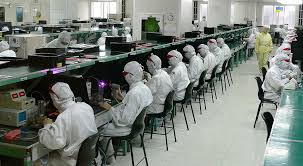
In the photo: Electronics factory in Shenzhen. Note that the photo dates back to 2005: Chinese investment in electronics is nothing new. Source: Wikipedia
IWhat Americans didn’t develop at home, they bought from Europe. In this respect, two British firms stand out with groundbreaking contributions to AI development: ARM and DeepMind.
While all eyes are trained on the AI race between China and America, is there a role left for Europe?
From the start of the digital revolution, and in spite of America’s lead, Europe has always had a fundamental role in digital research, a role often overlooked and even downplayed by the media mesmerized by Silicon Valley fireworks.
But the fireworks are dying down and getting messy now while China is on the rise.
America’s AI Roots in Europe
Let’s take a closer look at ARM and DeepMind, the two British firms that played a fundamental role in sustaining America’s lead in electronics.
There is a new party rising across Europe, a party shaped by Millennials who want a voice in their future: Volt Europa. The name says it all: Volt Europa, jolt Europe. An electrical charge to shake it out of its lethargy, give it new energy.
Volt is, of course, the international unit to measure the force of electric current. It’s a nice easy name that stays the same with the same meaning across Europe and all its languages and cultures. And, in the words of the party leaders on their website, “it fully represents our fast and efficient team”.
So who is this team and what does this party aim to do?
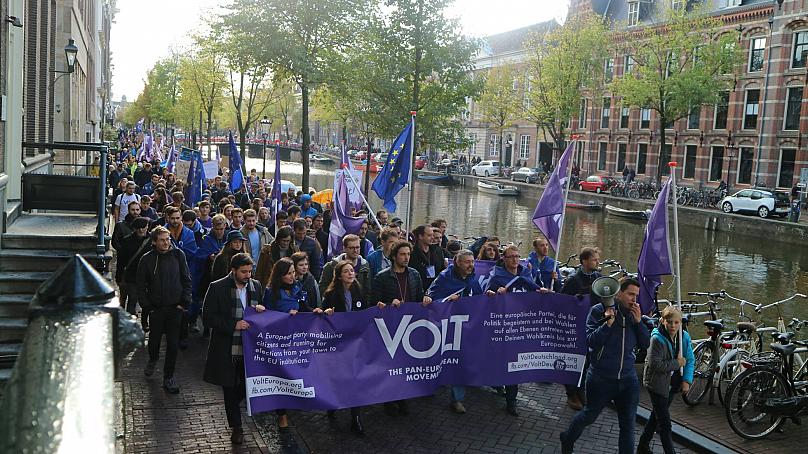
Volt Europa had an extraordinary start: in less than two years, it acquired over 20,000 adherents and it is active in 32 European countries with more than 300 teams. It is mostly a party of young people but it has attracted all ages, including older citizens horrified by what is happening to Europe these days. The oldest is a 92 year-old Netherlands citizen. Even more extraordinary: over 70% of its adherents have never been involved in politics before.
That means Volt is not a rehash of a dying party or a new current in a traditional party. It’s a totally new entity, a pan-European party aiming to have subsidiary parties in every EU member country. As Kai Kotzian, a 43-year-old Volt candidate for the European Parliament in Germany recently told the Frankfurter Wochenblatt: “Our perspective is different from that of other parties. We are not just looking at what’s good for Germany, but what’s good for the entire European Union. Since there is no European electoral law, in order to form a cross-European party, we had to found one in each country so we could vote.”
The first national Volt party was created in Germany in March 2018, now Volt has 12 parties at the national level. It covers all the EU members and beyond, including Switzerland, Serbia and Albania.
Among new parties with a pan-European vocation, Volt stands in a “leftist” centre. To its left, you have Dem 25, the party founded by the former Greek finance minister Varoufakis. To its right, you have The Movement founded by Steve Bannon, Trump’s former adviser and extreme right Breitbart News editor.
Bannon’s Movement, however, is paradoxical as a “pan-European” party. Its avowed aim is to weaken the EU, and if possible, destroy the European dream of a United Europe. Bannon plans to pull together all the European populist parties for a big win at the European Parliament elections. Not an easy task as populist parties are clearly nationalistic and often at odds with populists from other countries.
Volt, in contrast, is truly pan-European and committed to building up and strengthening Europe, standing on a “progressive” middle ground. It fights for sustainable growth and social justice. But it’s not as far to the left as Varoufakis’s Dem 25. Also, unlike Dem 25, Volt has no founding father image, like Varoufakis. Or, to compare it with the Five Star Movement, like comedian Beppe Grillo.
Volt is not a vertical, hierarchical structure. And it shares with the Five Star Movement a propensity to give a lot of weight – and a voice – to its base, using digital communication, social networks and participatory methods to develop its political platform.
Volt Europa’s Political Message
Volt Europa’s immediate goal: Win in the upcoming European Parliament Elections. Candidates were announced in 11 countries at a meeting in Amsterdam on 27-28 October 2019 – among them Italy, France, Germany and Spain. The hope is to obtain at least 25 deputies in 7 countries which would enable Volt to register as an autonomous parliamentary group.
The long-term goal: Reform Europe and give it a voice in the concert of nations. And the “reform” has nothing to do with populism’s backward, nostalgic message of restoring sovereignty and going back to Charles de Gaulle’s “Europe of Nations”. On the contrary. It is forward-looking, ultra-liberal and progressive, much like Macron’s plan to reform Europe or Carlo Calenda’s.
More Europe is good. A reformed Europe that works is better. Volt’s Amsterdam Declaration adopted in October 2018 makes for inspiring reading. This is indeed groundbreaking: Volt will campaign across Europe on a single common platform.
Did you notice something new here? Yes, there’s an announcement: IMPAKTER Up is launching! That’s an amazing new app for startups with socially responsible aims – “social good companies” – to match them with investors committed to a sustainable future.
Yes, our planet needs to be saved from rapacious, voracious capitalism!
My latest article on Impakter, updated 24 February 2019 with the news that Salvini is taking funds from Russia. Here is the opening:
Italy has a surprising weakness for populism à la Trump. It began over twenty-five years ago with Silvio Berlusconi and his Forza Italia party and is still going strong with the extreme-right populist Lega leader Matteo Salvini. Berlusconi and Salvini share the same worldview with Trump: a visceral attachment to national sovereignty (my country first!), a rejection of multilateralism and international cooperation in any form, and a determined anti-immigration and pro-business stance.
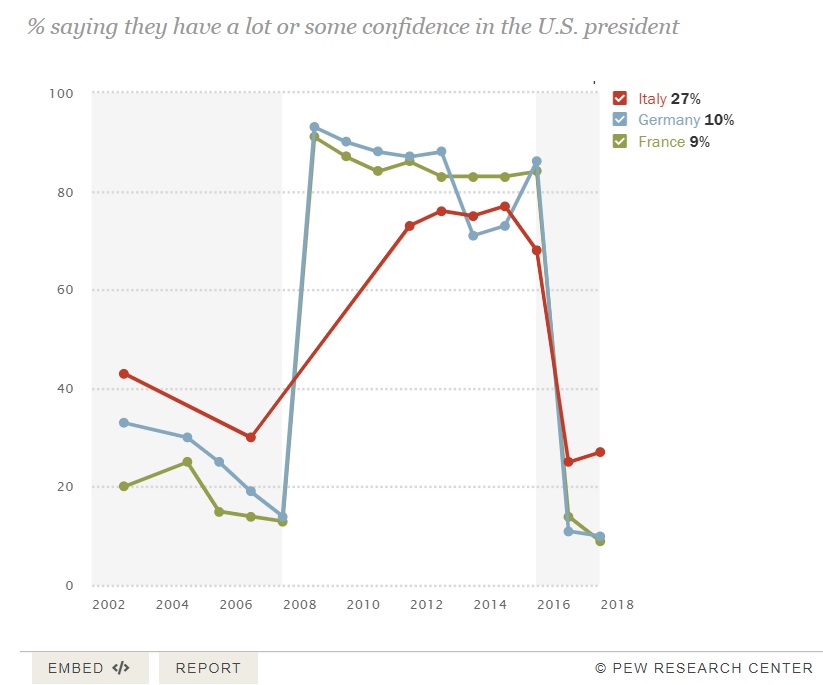
As to the Italian fascination with Trump, it is unique in the group of advanced, politically mature European countries that constitute the core of the European Union. Compared to fellow citizens in Spain, France and Germany, Italians are three to four times as likely to have “a lot or some confidence in the U.S. President”, as shown by a recent Pew Research Center survey (October 2018):
Trump does slightly better in the UK (28%), no doubt as a result of Brexit and Britain’s continuing “special friendship” with the United States. And, predictably, he does best in Europe’s most “illiberal democracies”: Poland (35%) and Hungary (31%).
Admittedly, Italy’s fatal attraction for strongmen is nothing new. Setting aside Mussolini and fascism and turning to modern times, we have Silvio Berlusconi, the TV mogul. Berlusconi has shaped Italian politics, opening the door to extreme right parties that were once banned because of their fascist roots. To understand how it happened and see where Salvini’s populism could lead Italy, it helps to look at his legacy.
Berlusconi’s Legacy: A Brilliant Start, Broken Promises and a Humiliating End
Much as Macron did with his party “La République En Marche”, Berlusconi created a party literally overnight, Forza Italia (“Go Italy” – note the nationalistic touch and the reference to Italy’s passion for football).
The start was even more explosive than Macron’s. Founded in December 1993, the party quickly gained a relative majority and won general elections three months later. That was the result of a skillful use of media campaign techniques on Berlusconi’s Mediaset, a near monopoly in commercial TV. The party’s earliest officials were Publitalia executives, the advertising arm of his business empire.
Forza Italia always was – and still is – Berlusconi’s “personal party”. And he proceeded to lord it over Italy, both as the head of the center-right coalition and serving as Prime Minister for a total of nine years. Considered the most influential politician since Mussolini, there is no question that he has shaped Italy’s politics and economy over two decades – unfortunately leaving the economy in shambles.
Yet he had vowed he would make his compatriots rich. Many believed him, seeing how rich he was himself. But Italy’s economic growth rate remained abysmal throughout. In 2010, only Haiti and Zimbabwe fared worse than Italy. Likewise, he couldn’t deliver on his promise to reform the slow and inefficient justice system, as his efforts at reform turned out to be personal moves to defend himself and his assets from prosecution. As to immigration, he was the first politician to tighten immigration rules in Italy and establish a special relationship with Libya to discourage inflows of migrants across the Mediterranean.
The most damaging result of the Berlusconi years was the return in mainstream politics of extreme right anti-establishment political parties, brought in and rehabilitated as Forza Italia’s partners: Umberto Bossi’s Lega (then called Lega Nord as it was both anti-Rome and anti-Southern Italy) and Gianfranco Fini’s National Alliance with deep roots in fascism.
2011, the height of the Euro crisis, was a turning point. In April, Berlusconi was put on trial, accused of paying an underage prostitute. By November, he was forced out of office. He left Italy in financial disarray, with an estimated debt of €1.9 trillion. He always claimed it was a “EU plot” by Brussels bureaucrats.
On 1 August 2013, he was convicted of tax fraud, banned from office and condemned to four years in jail that were commuted to “community service” due to his age (he was 77). In November of that year, the Senate expelled him from Parliament and he vowed to follow the example of Beppe Grillo, the comedian and founder of the 5 Star Movement, who was able to lead his party in spite of not being a member of Parliament Grillo has made it a principle in his party that anyone with a criminal conviction cannot hold a public office – himself included, since he was convicted of manslaughter in a car accident in 1981.
Today, at 82, Berlusconi is still in politics. Forza Italia has lost its luster and the Lega, that used to be his junior partner, is well ahead in the polls.
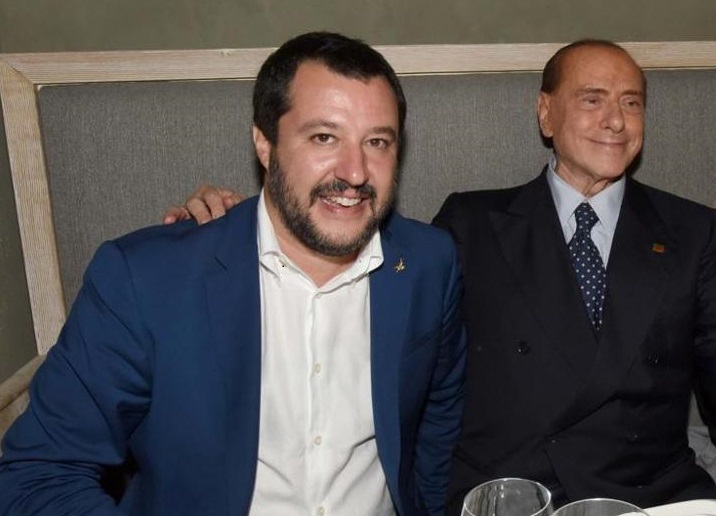
In the photo: Salvini and Berlusconi. That day, 7 January 2018, Berlusconi, Salvini and Meloni, the leader of Fratelli d’Italia, agreed on the distribution of electoral colleges Source: La Stampa, photo LaPresse
Is Salvini, Berlusconi’s heir, Italy’s Trump?
On 21 February, the Italian newspaper L’Espresso published shocking news: That Salvini’s party the Lega is likely to be secretly financed by Putin, to the tune of €3 million, with the goal of giving it a boost in the upcoming European Parliament elections and more generally spread discontent in Europe. This is of course not the first time that news emerge of Russian funding extreme-right, anti-establishment populist parties with the purpose of destabilizing Europe – notably Marine Le Pen in France is said to have received some €11 million from her friend Putin.
Yet the last ten days had been a turning point for Salvini with several wins. On 10 February, his party, the Lega, came first in local elections in the Abruzzo region, with 27,4% – a number oddly close to the one in the above-mentioned Pew survey rating Trump, suggesting that this could be indicative of the core support for any populist in Italy.
My latest article on Impakter, here’s the opening:
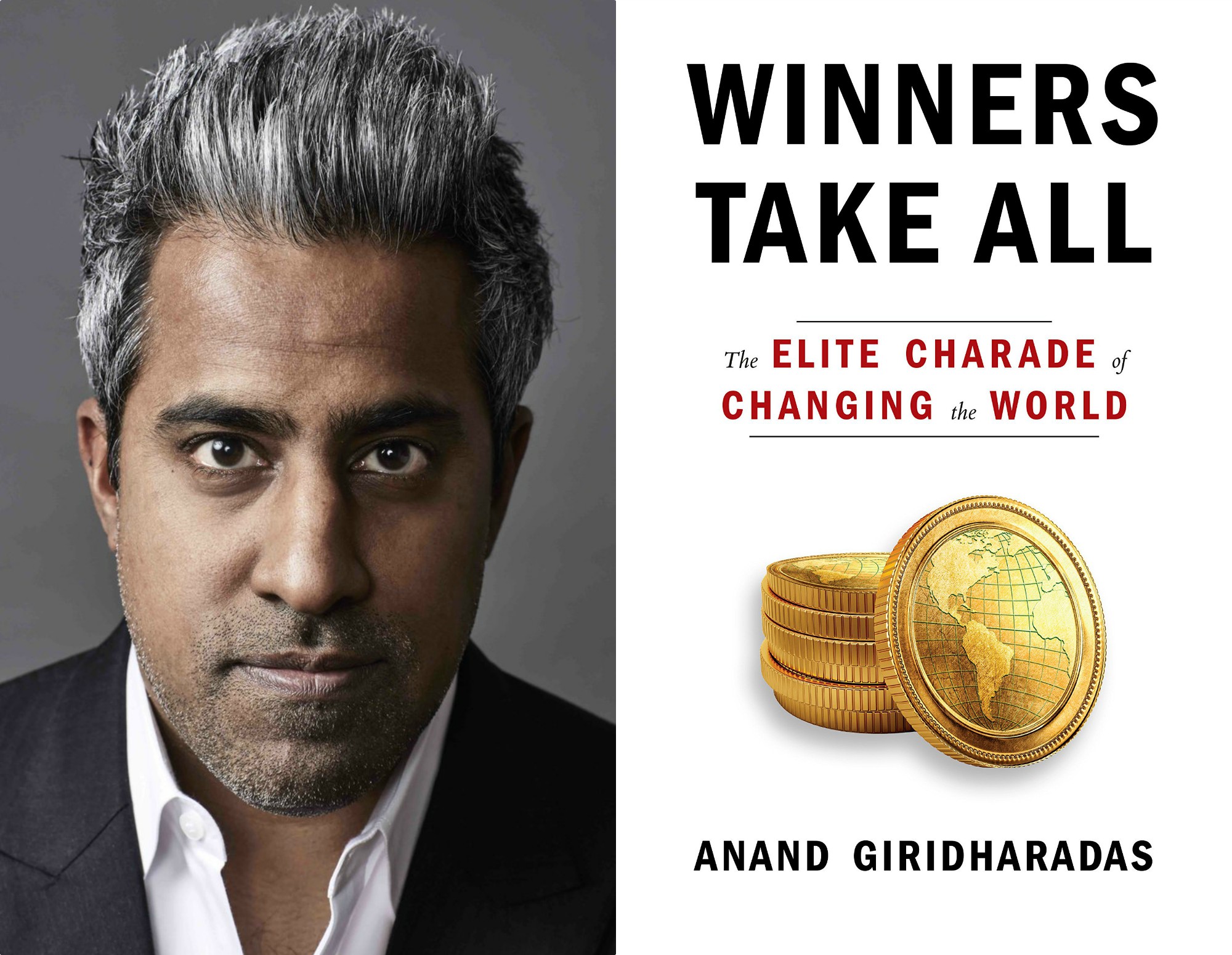
Looking back to the exceptional crop of 2018 bestsellers criticizing the state of our society, from rising economic inequality to populism and climate change, one book stands out: “Winners Take All” by former New York Times columnist and Aspen Institute fellow Anand Giridharadas. It skewers philanthrocapitalism, arguing that uber wealthy do-gooders, rather than changing the world, do well for themselves, preserving the status quo. What is needed is a move to more responsible giving.
When it came out in August 2018, the renowned American economist and Nobel laureate John Stiglitz, in praising it in a New York Times article warned that we should “prepare for a new genre” of books analyzing economic inequality and globalization: the kind that “gently and politely skewer[s] the corporate titans who claim to be solving such problems. It’s an elite that, rather than pushing for systemic change, only reinforces our lopsided economic reality — all while hobnobbing on the conference circuit and trafficking in platitudes.”
Since then, Anand Giridharadas has been active on the conference circuit but he has certainly not been “trafficking in platitudes” and he has stopped being gentle and polite. Instead, he has taken to “skewering corporate titans” with a vengeance, even going into their lairs, as he did when he gave this talk at Google in October 2018:
For the FT, Trumponomics was a “timely defence of the president’s policies” and in particular of his €1.5 trillion tax cut – and it predicted that, of the three books, this was the one most likely to become a bestseller “given the size of the conservative bulk book market” in the United States.
The prediction turned out to be wrong: Of the three, as of now, Giridharadas’ book is clearly the best seller, ranking highest on Amazon’s best sellers list (#252 and #1 for the philanthropy category), followed by Reich (#27,928) and far behind, Trumponomics (#85,183).
Perhaps many, if not most, American readers are tired of Trump.
The FT however does make an important point: What’s wrong with philanthropism in America is that the US has a uniquely favorable tax system that allows all kinds of charities to deduct taxes “regardless of whether they are effective”. Annual tax breaks amount to $50 billion, as much as the Federal government spends on energy, the environment, food and agriculture. Reich calculates that barely 20 percent of philanthropy benefits the poor, the rest mostly goes to education, culture (the arts) and religion (worship).
The FT draws attention to an important point made by both Giridharadas and Reich: Giving to education is problematic. It benefits wealthy district schools or charter schools, thus increasing American public education’s “savage inequality”. The FT clearly enjoys Giridharadas’ sense of “acute observation” and polemical tone, quoting him on Trump (though leaving out the last five words in the sentence):
By January 2019, as political leaders and corporate titans were flying to the World Economic Forum in Davos, Giridhadarads raised the tone. The press rushed to cover him. The Economist called it an “entertaining polemic”, subtitling its book review “The Davos Delusion”.
“Trump is the reductio ad absurdum of a culture that tasks elites with reforming the very systems that have made them and left others in the dust.”
On Bloomberg, Giridharadas baffled his interviewers, lashing out at Davos, calling it “a family reunion of the people who broke the world” and suggesting Davos should be cancelled:
…
The rest on Impakter (including the Bloomberg video), click here to read.
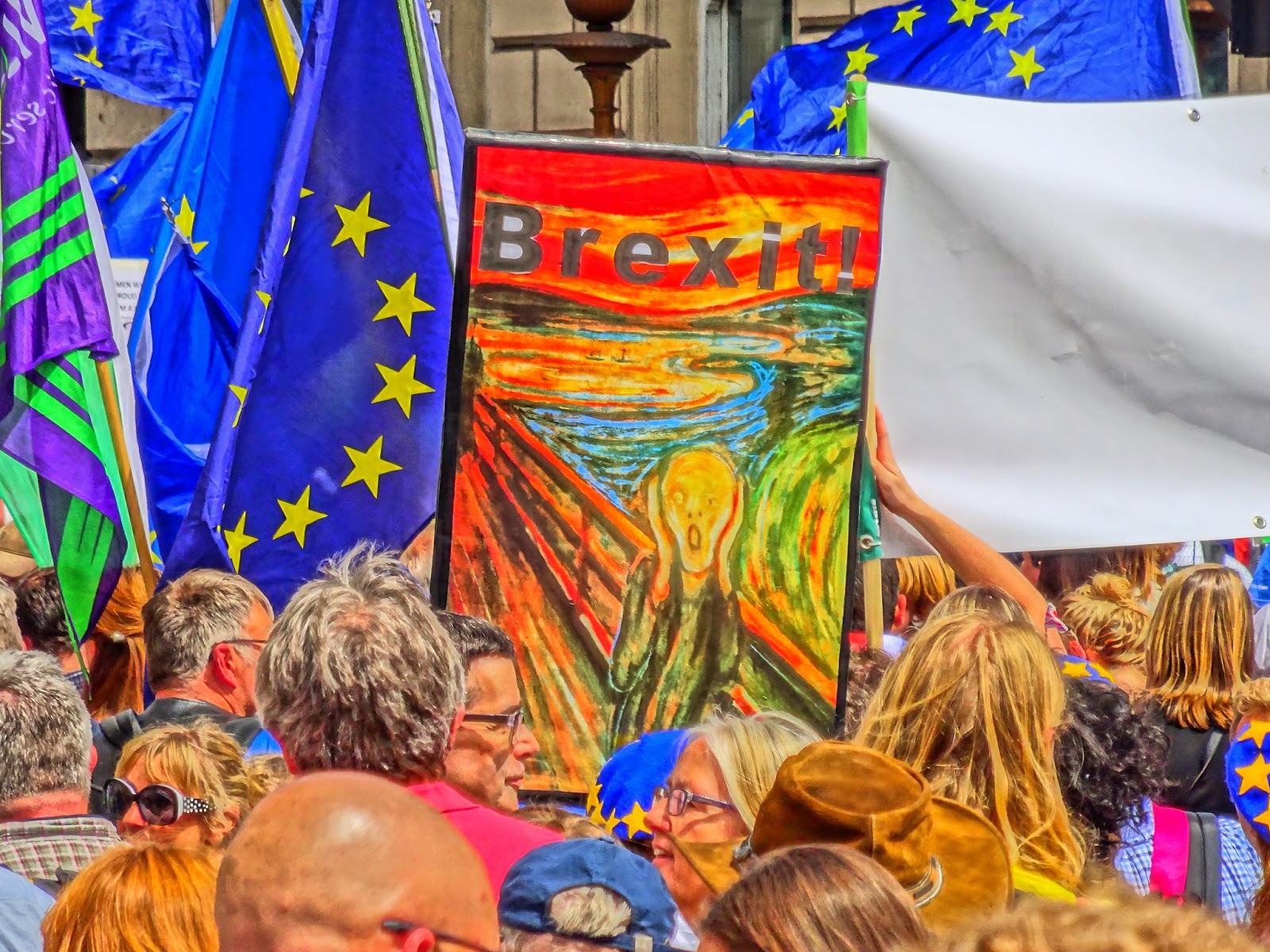
My Sunday article, just published on Impakter, I found a great featured image with Munch’s famous “Scream” (Creative Commons, photo by David Holt) and here’s the title:
Brexit: The Point of No Return? What Can Be Done?
And the opening:
Are we approaching the point of no return with Brexit? And is there anything that can be done? It can’t be proved, but it looks suspiciously like Prime Minister Theresa May is deliberately engineering drama in order to get her “deal” – the Withdrawal Agreement with the EU – approved by the U.K. Parliament. She seems to be pushing the clock to the last minute before midnight of 29 March – Brexit’s deadline, the date she set herself by triggering Article 50, now almost two years ago.
She’s aiming for that date like a straight arrow, telling Parliament that she sees no possibility of a second referendum. That’s something she has said many times over the past year: There will be no second Brexit referendum. And even less new elections. A proposed cross-party amendment to Theresa May’s Brexit plan calling for a “people’s vote” was ditched earlier last week because of lack of Labour party support.
Poor Britain, one could feel sorry that at this crucial juncture, the U.K.’s two leading politicians are clearly anti-Europeans and don’t have at heart the welfare of their fellow citizens. They are not the kind of people who will revise their opinions in the light of emerging evidence that Brexit is a very bad idea.
Theresa May started in the Remainers’ camp when she was still in Cameron’s government, but after Brexit, she saw her opportunity to become Prime Minister and she quickly jumped to the other side. Clearly, she won’t let go – not until she has Brexit where she wants, beyond the point of no return. As to Jeremy Corbyn, the Labour leader, he has been a Euro-skeptic all his life and he’s not about to change his opinions, even if Brexit in fact hurts the working classes the most.
Bloomberg’s Brussels Edition calls it “Brexit Fog” as no deal for an orderly withdrawal is yet in sight. As far as the EU is concerned, the deal struck with Prime Minister Theresa May last month is the only possible one, nothing else can be envisaged. May is currently trying to win over Labour Party rebels to her deal and more generally, laying the groundwork for a possible delay on Brexit. At the time of writing, nobody knows whether she can succeed or not.
Brexit is unquestionably the most damaging foreign policy move the U.K. has ever contemplated in its whole History. With Brexit now approaching the point of no return, the costs of a “no deal Brexit” are becoming painfully clear to everyone.
No-Deal Brexit Damage to the U.K.
The U.K. food industry is in a panic, expecting a food emergency to explode after March 29 when all the borders with the EU will close down. On 28 January, UK food retail chief executives issued a “no-deal Brexit” warning in a letter that was also signed by Marks & Spencer managers. They noted:
“Our supply chains are closely linked to Europe – nearly one third of the food we eat in the UK comes from the EU. In March, the situation is more acute as UK produce is out of season: 90% of our lettuces, 80% of our tomatoes and 70% of our soft fruit [are] sourced from the EU at that time of year. As this produce is fresh and perishable, it needs to be moved quickly from farms to our stores,”
The problem is the “just-in-time” food supply chain. If it is disrupted, it will be a disaster foretold.
Food retailers are stockpiling food where possible but all the available frozen and chilled storage space in the U.K is already in use and there is little further general warehousing space. The UK authorities might decide not to check products at the border, but the French have already announced they will enforce sanitary and customs checks at Calais as they are forced to do on all exports from the EU to outside countries. As a result, freight trade at Calais and Dover is expected to be reduced by as much as 87%.
In short, food will cost more and the poorest will be hit the hardest.
But food is not the only industry hit by a no-deal Brexit – all areas, from fashion to cars are going to hurt, and the working classes in particular will feel the pain as factories shut down and jobs move abroad.
The problem is that for 30 years, industry supply chains have been built to fit into the EU system. To repurpose them will be a gargantuan task, made all the more difficult as the U.K.’s free entry into the vast EU market closes up, discouraging investors and extra-European manufacturers like the Japanese who have used the U.K. as a door to jump into Europe.
The so-called “Ireland backstop” is another potentially catastrophic problem. The whole of Ireland, North and South, does not want the clock to be turned back to a state of war. In the words of Irish Foreign Minister Simon Coveney:
“It is vitally important that politicians in Westminster understand the overwhelming wish across society in Northern Ireland not to return to borders and division of time past”.
No-Deal Brexit Damage to the E.U.
The damage will be far more serious than is commonly thought.
…
To read the rest and find out how badly it will go for the EU, click here.
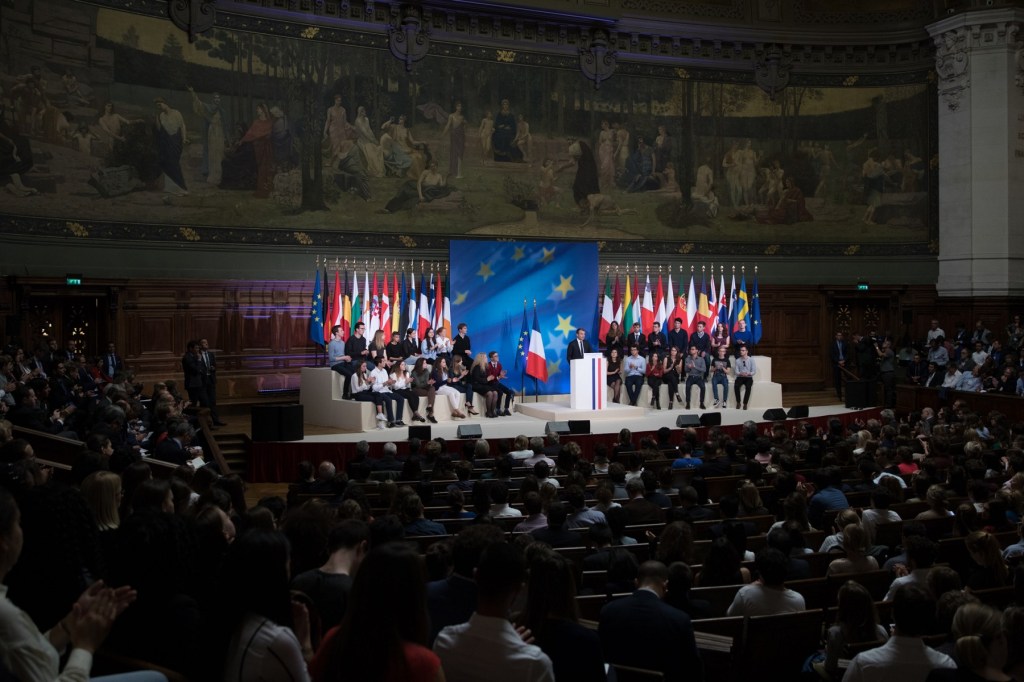
French President Macron addressing the Sorbonne 26 September 2017 Source: Elysées
Everyone agrees that to reform Europe is a priority. And there’s only one logical way to do it, as proposed by French President Macron. His plan is simply brilliant. Exactly what Europe needs now. But there are many reasons why it will not be adopted – in spite of its brilliance and evident relevance.
It should come as no surprise that the author of this reform plan is French. France has always been the country of logic since Descartes’ days. The sad thing is that logic is not a winner these days with nationalist populism reviving everywhere – including in Germany and Italy and in most of Central and Eastern Europe. There are other reasons too militating against Macron’s plan: Germany’s fixation on austerity, Italy’s anti-establishment government. Italy, as I will show, is the unexpected linchpin – the country that could kill the dream of a United Europe.
First, let’s examine Macron’s plan, and then see why its chances for success are slim. Slim but not totally hopeless: There is an on-going revival on the left, especially with the Greens in Germany and some inspiring figures like Carlo Calenda in Italy.
Macron’s Plan to Reform Europe: Making it a Sustainability Champion
So what is Macron’s plan? As Bloomberg put it, Macron’s goal is to make Europe “fit for a globalized world”. In a landmark speech at Paris’ Sorbonne University in September 2017, he outlined a six-pillar plan (he calls them “keys”) to reform Europe and make it “sovereign, united and democratic”:
For the video of the full speech in English translation, click here
An article published on Impakter that I am particularly proud of: I got compliments from a great professional journalist Judy Bachrach who is also a contributing editor at Vanity Fair, the author of bestselling “Glimpsing Heaven” and professor of investigative journalism at John Cabot University. Here is the first part (concerning the U.S. and Trump); the second part is about Europe (and Salvini):
Populists make empty promises. They exploit people’s discontent, raise expectations but cannot deliver solutions. They claim to represent the “will of the people”. Yet they spread lies and accuse leaders of other parties, particularly progressive ones, to be the root cause of all the problems people face. Populists thrive on divisiveness and partisanship in both America and Europe. And it is happening in the world’s oldest democracies, places that should have been inured to the populists’ siren songs.
Two recent cases are emblematic of what is going on.
Case # 1: The United States
Consider America. Trump constantly attacks the “failing New York Times” for spreading “fake news”:
Ms. Abramson is 100% correct. Horrible and totally dishonest reporting on almost everything they write. Hence the term Fake News, Enemy of the People, and Opposition Party!
He flatly overlooks the fact that the New York Times has never been more successful, with extraordinary financial results and a fast-growing audience – Forbes estimates NYT’s online subscriber base to be its biggest value driver, and forecast this growth to pick up in the coming years and reach 4.5 million by 2022. A remarkable performance at a time of great difficulty for the industry battered by digital publications and online news.
But Trump, like all populists, has an Achilles’ heel: He can’t deliver on his promises. And he never will. Because his promises are nonsensical, none of them can resolve the problems they are meant to address.
What is happening now with his promised border wall is only the start. He incautiously caused the shutdown of government, sending home 800,000 government employees without pay. And he is doubling down on his mistake, with false accusations at the Democrats when everyone knows that the Democrats have nothing to do with it.
Trump, and he alone, is the cause of the mess. And if the shutdown lasts a year or more as Trump says he’s ready to do, don’t go ask all those employees sitting at home how happy they are with him or what they think of his MAGA policies.
But what about employment and Trump’s promise to create more blue-collar jobs to revive the rust belt? The just published employment data was fantastic, almost double what economists had predicted, shattering Wall Street forecasts of doom: 312,000 jobs were created in December, bringing total employment gains in 2018 to a three-year high of 2.64 million. The Labor Department adjusted its figures for October, raising them from 237,000 to 274,000 and for November, from 155,000 to 176,000.
Cherry on the cake: the average wage rose 11 cents, or 0.4%, to $27.48 an hour. OK, 0.4% doesn’t sound like a big deal, but it’s an average and it means some people did get ahead. And if the employment rate crept up to 3.9 percent from a 49 year low of 3.7 percent, that’s a small creep and it was because more people, attracted by a booming economy, entered the workforce.
So has Trump delivered on his promise? First, it’s too soon to tell. The impact of whatever Trump did will take some years to show up. No political measure is ever instantly translated into measurable economic effects.
Second, we need to remember that Trump in his first two years has only really achieved two things:
(1) deregulation of the environment, paralyzing the Environmental Protection Agency – a boon for the fuel and coal industry and steel; and
(2) an unprecedented tax break for Big Business and the One Percent – at the expense of the middle class and the lower blue-collar working class.
Both measures will need time to impact the economy in full, but we already see early signs that can tell us which way things will be going.
The expected early burst due to Trump’s tax break is much like a wave of fresh funding currently translating into higher overall employment and attracting new people in the labor market. Problem: It is not going into every nook and cranny in the economy, as the Republicans expected.
There is a good reason for this shortcoming. A considerable amount of the funding freed from the tax is not going into new investment, but instead going into stock buybacks to please shareholders. For now, that makes Wall Street and the One Percent very happy. But every cent and dollar going into stock buybacks means it is not going into Main Street and jobs for blue-collar workers.
The amounts diverted into stock buybacks is extensive: By end 2018, it is estimated that of the announced 1.1 trillion in buybacks, a record amount, already $800 billion have actually been purchased. Record buybacks are usually a sign that CFOs believe their stock is undervalued. But not all buybacks have happy outcomes. Consider the case of Apple that was recently badly hit by dropping sales for its smartphones in China:
Then there’s another problem: Robotization. This had nothing to do with Trump’s policies. The trend to automation started a long time before Trump reached the White House. Except for one thing, he should have foreseen the problem.
A good leader sees farther than his voting base. He should have understood that jobs in the coal and steel/aluminum industries that existed twenty years ago are no longer there because of automation. For example, Austria boasts of an almost entirely automated steel plant: It only needs 14 people to run.
The same is true for the United States, as a Brookings article abundantly documents. The last time employment peaked in the coal industry was in the 1920s. Already, by 1980, it was plunging – from 785,000 in 1920 to 242,000. And by 2015, it had lost 59% of its workforce compared to 1980 – most of the loss due not to trade but to automation.
The change from pit mining to surface mining (using explosives and considerably less labor) accelerated the move. Capital intensive highly productive technologies are already in use everywhere and it is expected that over the next 10 to 15 years, their deployment will be ramped up.
But Trump didn’t see that coming. He is not interested in either automation or the opportunities opened up by Artificial Intelligence.
As a result of his tax cut, jobs in the steel, aluminum and coal industries have rebounded, sure, but only modestly. Not enough to change the equation in the rust belt. Moreover, Big Business hasn’t changed its modus operandi, as the recent decision of General Motors to close down plants in the U.S. and send 45,000 people home shows.
Bottom line, Trump is only interested in easy-to-sell slogans, not in resolving difficult problems.
Case # 2: Europe
Consider the European Union, and take a close look at one of its best-grounded, most emblematic democracies: Italy. The country where after the disaster of World War II, a particularly representative democracy was set up with a carefully crafted Constitution, intended to avoid the dictatorship of the majority and give equal representation to all citizens, excluding none.
The rest on Impakter, click here. Let me know what you think!







 Claude Forthomme's Blog about Social Issues and Books
