Amazon Has Done It Again for Self-Publishing!

The wonderful case of Swedish self-published author Carl-Johan Forssen Ehrlin is there to prove it! Thanks to Amazon, this author, a psychologist who has founded a psychological coaching company and published several “help” books in various genres since 2006, has hit the jackpot.

News came out in this summer that something strange was happening on Amazon’s printed books best selling list: big best-sellers from established authors (like Harper Lee‘s Go Set a Watchman) were being displaced from their top position by a book for children from an unknown Swedish author with the weird title The Rabbit Who Wants to Fall Asleep – a book specially designed to lull restless children to sleep.

The news were repeated in the press both in America and in the UK (for example, here and here, both pieces dated August 15) and now the New York Times has just learned that in September Mr. Forssen Ehrlin had landed a juicy deal for multiple books, including re-issuing his first book unchanged (but on better quality paper), with one of the Big Five: Penguin Random House no less.

The interview he gave to NYT is an eye-opener. Curious? You can read it here.

So what is the secret of Forssen Ehrlin’s success?

To begin with, a huge number of readers’ reviews – now already over 900 on Amazon.

Next, a well-orchestrated presentation. The NYT felt the illustrations looked a little “amateurish” – perhaps they do, but Penguin Random House is (wisely) maintaining them and (I personally think) they have a lot of charm, and obviously a lot of readers have felt the same way. As they say, if it ain’t broke, don’t fix it.

Also, an attractive, professional author website. Take a look here and see for yourself. The site is as much about the author as it is about his books, well balanced, convincing.

Last but not least, an unique sales pitch. The author presents himself as a trained psychologist and life coach, someone “in the know”, who can help parents in the delicate task of relaxing their children at bedtime. His book meets a broadly perceived problem, et voilà, you have a best-seller on your hands, with desperate parents loading up on the book!

Perhaps the most extraordinary aspect of this story is the fact that this is NOT A KINDLE SUCCESS STORY. It’s a Create Space success, Amazon’s service for self-publishing printed books. 

We’ve been used to read about Amanda Hocking, Bella Andre and Hugh Howey –  they all made it first by hitting the Kindle’s best selling lists.

Carl-Johan has done it differently, with a printed book.

And, not content to break new ground format-wise, he’s done it genre-wise too. This is not a romance, this is not a thriller or science-fiction, it’s a children’s book.

Congrats Carl-Johan, well done!

 Carl-Johan Forssen Ehrlin’s website (Screenshot)

PS. This story can also be construed as another confirmation that the digital format is not particularly adapted to children’s books. Mr. Forssen Ehrlin was wise to choose a printed book format, that is what parents want to do with their children, sitting on their bed after dinner, thumbing a book…

Your views?

Comments Off on Amazon Has Done It Again for Self-Publishing!

Filed under book marketing

Boomer Lit Three Years Later: What Next?

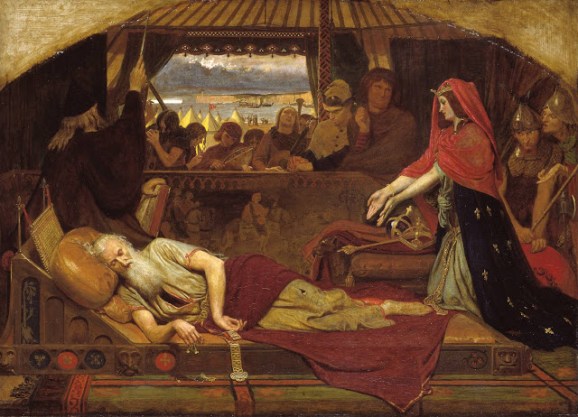
Lear and Cordelia 1849-54 Ford Madox Brown 1821-1893 Purchased with assistance from the Art Fund and subscribers 1916 http://www.tate.org.uk/art/work/N03065

Lear and Cordelia 1849-54 Ford Madox Brown 1821-1893 Phttp://www.tate.org.uk/art/work/N03065

In a way, Boomer Lit has been around for ever. Any book dealing with the challenges of “mature life” (meaning over 50) could be said to be “Boomer Lit”.

And now that some 78 million baby boomers in the US have reached 50 or are older – and that’s a big segment of the American population – the term Boomer Lit given to the kind of books they want to read has truly come into its own.

Why do I claim “Boomer Lit” was founded three years ago? Some people may say they’d heard the term before, that it was “floating in the air” and they could well be right.

But something specific happened three years ago that made it literally come out of its chrysalis and be born as a new genre –  a genre, I’m convinced, destined to become a great marketing success, given the sheer number of baby boomers. Not just in the US but around the world. And these are people who are rapidly reaching retirement age or are already retired…which means they’ve got plenty of time on their hands to read!

The Love Story stars, reunited today, see here

So what exactly happened three years ago to launch Boomer Lit? By chance, at this time of year (actually September 2012) I had just published a novel about a man facing a new phase in his life after retirement and the choices he makes threaten his marriage.

My problem was I didn’t know in which genre to place it. Romance since it dealt with a marriage relationship gone awry? Yes, but the man is over 60, and he has a love adventure with a woman in her 50s.

As we all know, “classic” romance is like Segal’s Love Story, all about young people. Also my book drilled in depth with how it feels like when you stop working and the rug is pulled out under your feet. Not the usual stuff of romance!

How to market such an odd book that didn’t fit anywhere?

That’s when I turned to a Kindle Forum thread for listing new books under specific genres and asked the moderator to allow the addition of a new genre aimed at Baby Boomers (I figured they were my audience). My request was granted and that boosted my confidence. I felt I was on the right road.

Happily armed with this new Amazon avenue that had opened up for marketing my book, I turned to Goodreads, looking for a group to discuss Baby Boomer novels and possibly get a chance to talk about my book and list it and reach out to more people.

Tough luck. I found no such group anywhere on Goodreads (and there are thousands of groups dealing with thousands of different themes!).

Determined to launch my book, I wasn’t discouraged. I’d been already fairly active on Goodreads for years and achieved the status of “librarian”, so it was a no-brainer to found a group to discuss Baby Boomer novels – or BB novels as I called them, I liked the humorous, facetious aspect of this term. If YA was for Young Adults, surely BB was for Baby Boomers?

I started the group in October 2012 with an explanatory pitch around this BB novel concept and put up a photo-shopped picture of my husband reading his Kindle ( washed over in blue color letting his hair show white – he actually has dark hair!).

By December 2012, the group had attracted over 50 extremely enthusiastic and active members and I started to write about in several online publications  and the Baby Boomer ball got rolling (for details on how it went, click my Boomer Lit tab above)…

In fact, today, three years later, the group has grown to nearly 600 – most of them, if not all, Boomer Lit authors.

That’s a lot of writers who claim to be writing Boomer Lit!  Writers who belong to the Group know that they also have at their disposal a Facebook page to announce their books or special events and a Twitter account (@boomerlit. To support Boomer Lit events, there is a dedicated hashtag: #boomerlit

To go to page, click here

In the spring of 2013, the Goodreads member of our BB novel group discussed the title of the group and there was a unanimous agreement that it should be called “Boomer Lit” because it didn’t cover just novels but also memoirs, poetry etc.

And there was a pointed discussion about the very nature of Boomer Lit: did it cover just challenges facing the “third age” or did it  also evoke the past, what it was like growing up in the 1960’s and 1970’s? I’ve always felt that the former was truly Boomer Lit while the latter was not. In my opinion, nostalgia pieces – whether a poem, a novel or a short story –  that deal with, say, a first love that happened some 40 years ago should still be classified as YA romance and not Boomer Lit. Why? Because it features, yes, a “young adult” (or maybe not so young, perhaps someone in their twenties) – but surely not anyone over 50!

At least that was my view and I fought for it, but not always winning that battle. Many Group members felt nostalgia was definitely part of Boomer Lit even if it dealt with a first love.

I believe this is the kind of intellectual “battle” only a Big Publisher could win.

That’s why Boomer Lit, to get truly established and go mainstream, needs to have a traditional publisher, preferably one of the Big Five, set up a Boomer Lit imprint. With a clear definition of what the term Boomer Lit covers and a clear outreach strategy to Baby Boomers.

I’m convinced such an imprint, correctly launched, would automatically access a huge market. Some authors have already made a splash with books that are clearly “Boomer Lit”, notably “The Best Exotic Marigold Hotel” that’s been turned into two films, and there’s no reason that many more Boomer Lit authors of quality cannot be found.

Source: click here

For a partial list of Boomer Lit books, check the Wikipedia entry, here. A publisher could also ask its editors to look among the members of the Goodreads Boomer Lit group. The group discussed a number of books and those discussions were very fruitful in helping to define what was and what was not quality Boomer Lit. And all those discussion threads are online, easy to access.

Furthermore, I’m pleased to report that the Goodreads Boomer Lit Group has started a particularly interesting thread about Boomer Lit, its challenges and potential as a major genre, to read it click here.

Yes, Boomer Lit has a future and in America, its future is 78 million strong! The first publisher who wakes up to this opportunity and establishes a Boomer Lit imprint is likely to be richly rewarded.

Your views? What do you think you can do to help put Boomer Lit on the map?

Comments Off on Boomer Lit Three Years Later: What Next?

Filed under book marketing

ON THE LAUNCH PAD – ANYBODY GOT A MATCH?

So the cat is out of the bag, I did read an early draft of this book and I loved it! Can’t wait to see it published, I just know you’ll all love it as much as I did!

Comments Off on ON THE LAUNCH PAD – ANYBODY GOT A MATCH?

Filed under Uncategorized

Keeping families connected during Ebola quarantine

The Internet overcoming quarantine, what a great story!

Comments Off on Keeping families connected during Ebola quarantine

Filed under Uncategorized

Global Governance 2.0: insights from former Australian Premier

An important read. A great insight into what makes the United Nations irreplaceable.

Comments Off on Global Governance 2.0: insights from former Australian Premier

Filed under Uncategorized

Let debtor nations leave euro, say German experts – FT.com

I totally subscribe to the comments made by Dr. Alf. Very sound.

dralfoldman's avatarDr Alf's Blog

Embed from Getty Images

This is an important read from the FT, citing a report from Germany‘s Council of Economic Experts.

via Let debtor nations leave euro, say German experts – FT.com.

Whilst the FT’s article is a good read, it’s well worth reading the evidence from the German experts. You can rest assured that it is being avidly read by mainstream economists around the world.

I read the executive summary from the German experts and many of the points are sound from a Germanic view of Europe. However, there are some fundamental weaknesses. Firstly, every international mainstream economist has been arguing for years for Germany to reflate, create some controlled inflation, to give the rest of Europe some breathing room. Secondly, the obsession with fiscal balancing ignores export imbalances (see Bernancke’s argument) – it also fails to address the economic case for top quality…

View original post 35 more words

Comments Off on Let debtor nations leave euro, say German experts – FT.com

Filed under Uncategorized

Working to survive: Yasmeen’s story

A heart-breaking story – this should never happen to anyone…

Comments Off on Working to survive: Yasmeen’s story

Filed under Uncategorized

I am closing down this blog…

No, I haven’t abandoned you, my dear readers! I continue to publish posts on my other blog site here:

http://claudenougat.blogspot.it/

For a while, I experimented with publishing on this blog site here, using it as a “mirror” blog for those who don’t like Google and don’t wish to post comments there. But, as I am working hard on my new book about the United Nations, I have less and less time to duplicate posts. So please forgive me, you’ll find my new posts (I publish once a week) on my Blogspot address, and if you don’t like to leave comments there, you can contact me directly on my email or on Twitter and Facebook. I’ll be happy to read you and answer!

Comments Off on I am closing down this blog…

Filed under Blogging

Sometimes You Just Have to Let Yourself Go…

Sometimes you have to leave behind the pains of the world, the pressure of work, your responsibilities to all your loved ones and… take a walk! Breathe deeply, take a few steps outdoors and then some more, and yet more, for an hour or two, until, for a few heady moments, you feel FREE…

That’s exactly what I did a few days ago, it was a cool spring day on Lake Trasimeno, in the heart of Italy – a lake that straddles Tuscany and Umbria. It wasn’t at sunset (like on the cover of my book “Crimson Clouds”), it was midday. A cold wind was blowing but the sun shone bright, the birds sang, and horses happily grazed in the fields. Here are some of the images I took on my smart phone that I want to share with you, starting with the lake:

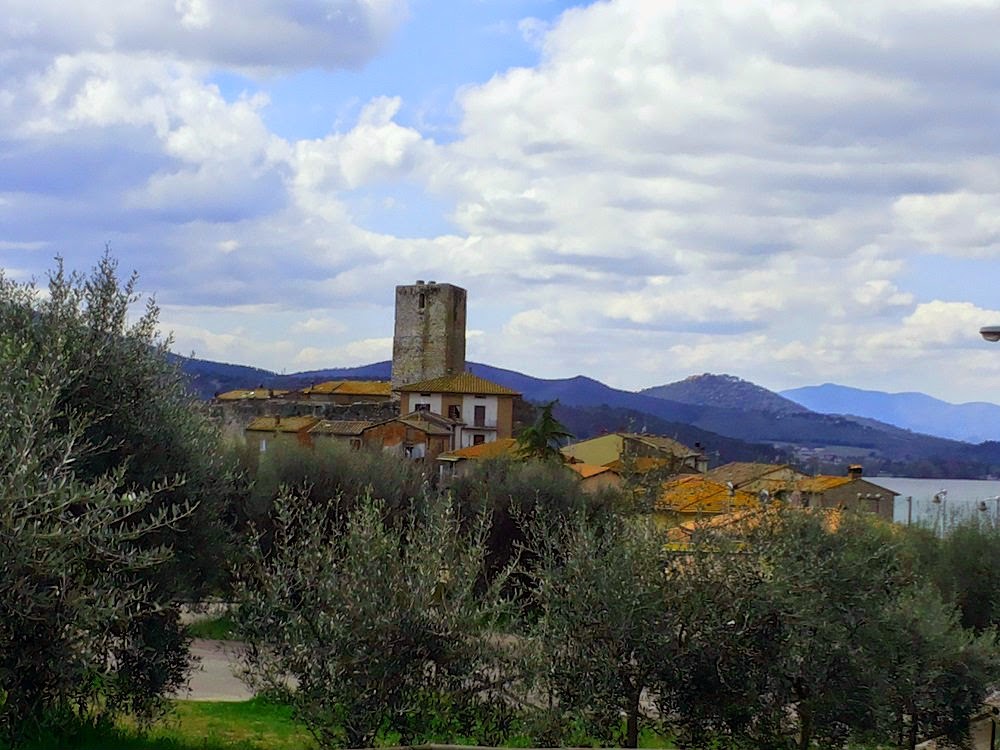
This is Isola Polvese – an island that is a natural reserve – and the shot is taken from high up. In fact, we had driven up to the small, medieval village of San Savino, with its characteristic tower:

You can glimpse the lake in the back, to the right. The tower dates back to the 12th Century and is part of a fortress – not a place you can actually visit, people still live in it. Here it is:

The castle was restored – or rather rebuilt – in the 14th Century. You can learn more about San Savino here, and if you want to spend sometime in the village, you can even rent small flats with great views – but be warned, the place is so small that there are no shops, no restaurants or cafés and that, in Italy, is very rare. Most villages have at least a café. But you’re very close to the Lake and the pleasant little town of San Feliciano, from where you can take a ferryboat to Isola Polvese.

We took a walk around the back of San Savino, going beyond the nice, old cemetery and found this jolly horse:

He quickly noticed us and came up:

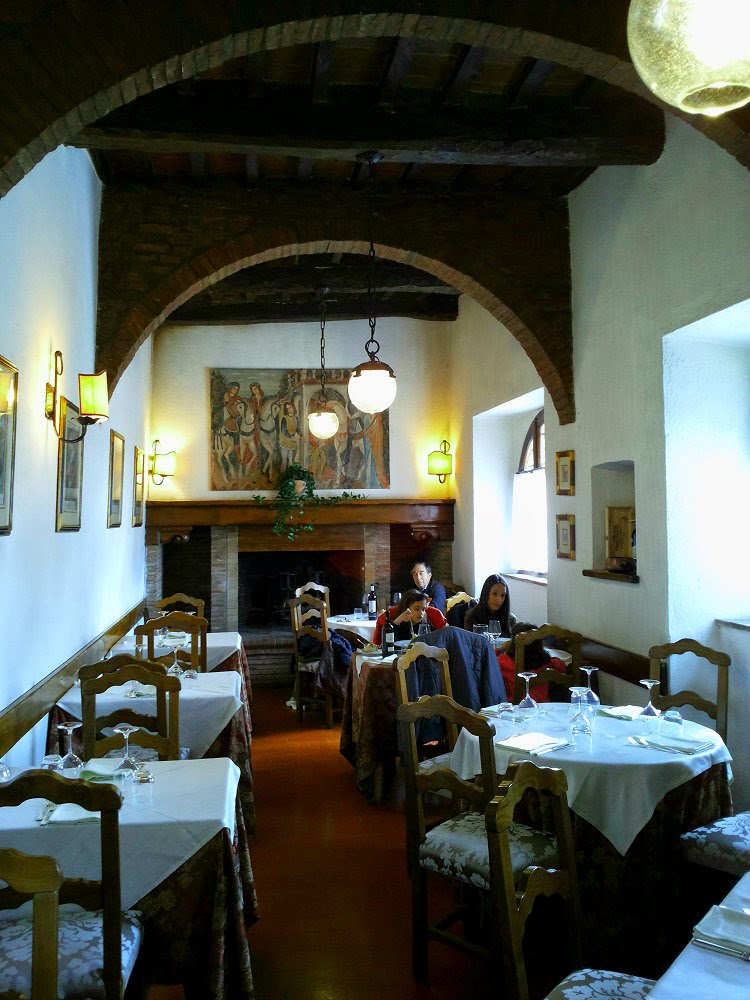
After that encounter, we felt ready for lunch and drove back towards Perugia  – ten minutes – to the Osteria dell’Olmo, a Seventeenth Century villa turned restaurant. The setting is a pleasure, the dining room with a fireplace is particularly nice in winter:

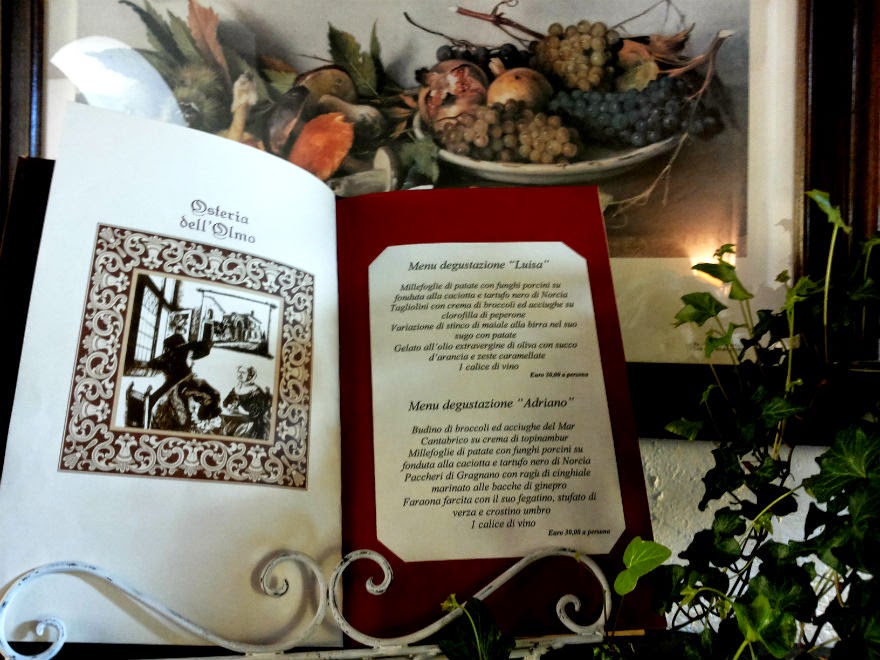
Overtime, the food has had its ups and downs but now they have a new chef and we ate very well, a superb steak and fried spring potatoes with the skin on, very tasty. But more complex menus are available:

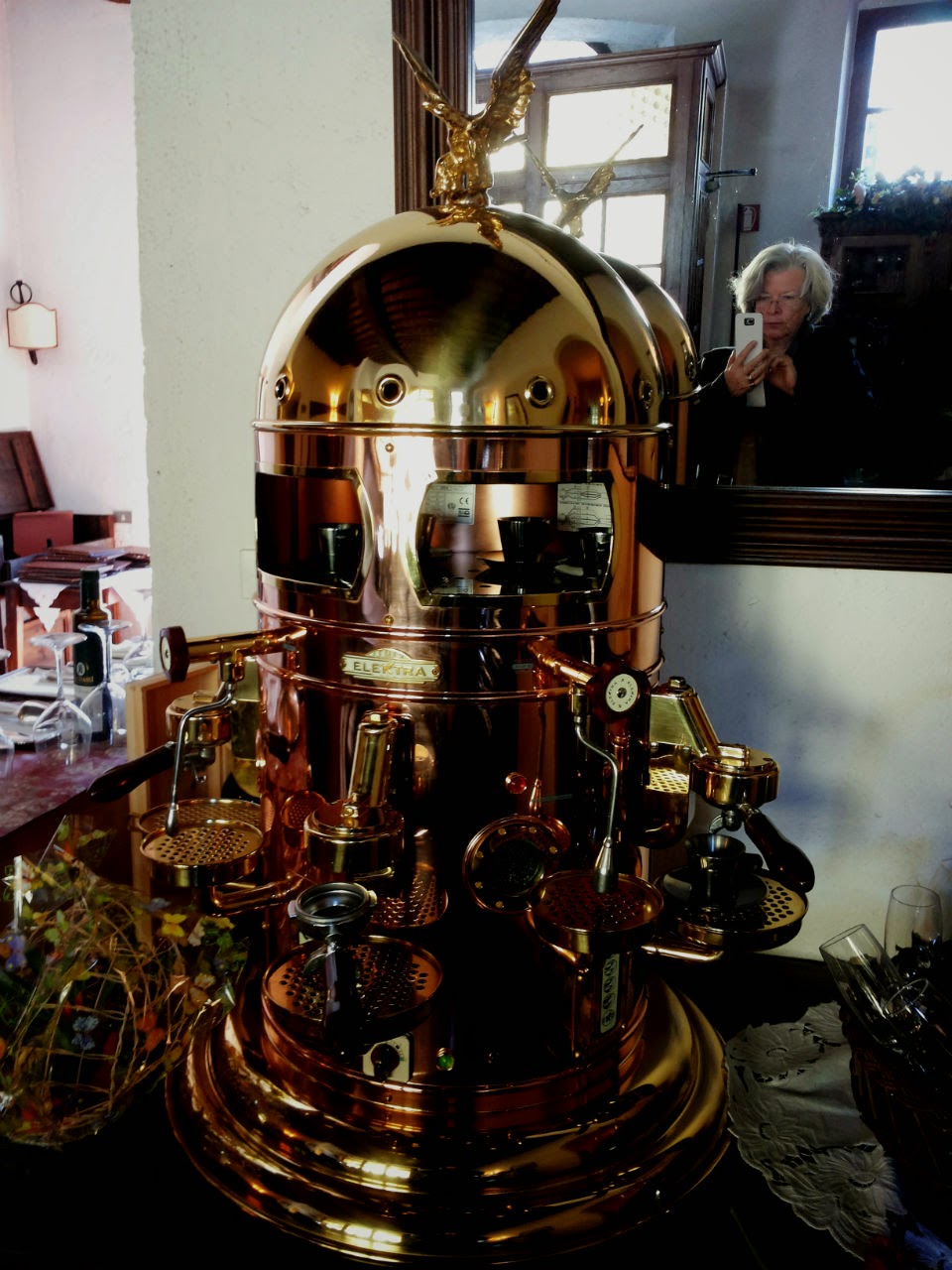
And they have a delightful coffee machine dating back to the 1920s (don’t worry, it’s not in use!):

Yes, the person in the mirror is me, bent on taking this picture…

In summer, you can eat outdoors, not the case that day (much too cold). But when we looked outside for the restaurant owner who had disappeared in the course of our meal, we found him busy taking care of a herb garden he had recently laid out on the terrace in neat white boxes:

Gardening is an Italian passion!

Comments Off on Sometimes You Just Have to Let Yourself Go…

Filed under travel

Chasing the Flame…

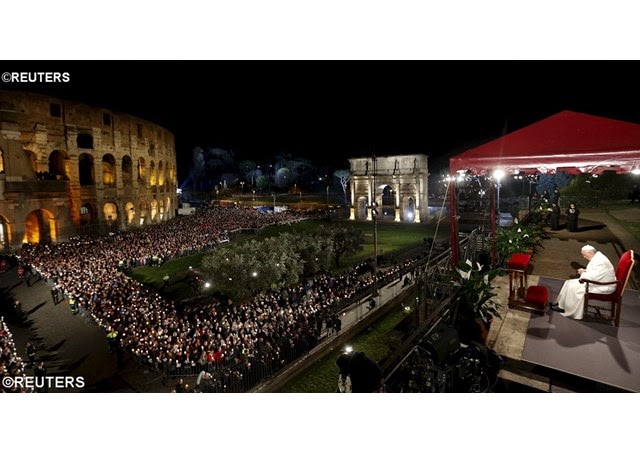
This week leading to Easter was an authentic Via Crucis for some 300 innocents massacred  by demented people: half of them were hapless tourists flying on Lufthansa’s low cost GermanWings, the other half, university students in Kenya who were shot and decapitated because they happened to be Christians.

The Pope had unforgettable words on Holy Friday for the Christians who were killed and for all the senseless violence permeating our society. Referring to the Christ’s Via Crucis, he said “In you, divine love, we see also today our persecuted brothers and sisters, decapitated and crucified for their faith in you, before our eyes and often with our complicit silence.”

Whether Christian or not, let us all agree that we cannot be silent. That something must be done – all of us can do something either at work or on our days off. And I was reminded of Sergio Vieira de Mello from Brazil, a man who dedicated his life to humanitarian causes and was horrifically killed in the line of duty. Samantha Power wrote an unforgettable book about Sergio – a man defined by Stephen Balbach, one of the reviewers of the book, as the “ultimate go-to guy”, in his words:

Sergio Vieira de Mello of Brazil (simply “Sergio” to many) was the personification of what the United Nations could and should be. As Paul Bremer’s adviser Ryan Cocker once said, “Sergio is as good as it gets not only for the UN, but for international diplomacy.” Sergio was the UN Secretary General’s “ultimate go-to guy”, a nation builder in the world’s toughest spots like East Timor, Cambodia, Kosovo. No one who met him – from George W. Bush on the eve of the Iraq War, to the Khmer Rouge, to Slobodan Milosevic – came away untouched by his intelligence, physical bearing, charisma and integrity. It was a major blow to the world when he and 14 other UN staff were killed on August 19th 2003 by an al-Qaeda suicide bomber at the Canal Hotel in Baghdad, an event that has become known as the “UN’s 9/11”.
Yes, another victim of terrorism – one who died twelve years ago. I only recently came across Samantha Power’s book about him (it was published in 2008), in the course of researching my upcoming book about the United Nations. And I was immediately taken in by what is in fact a gripping read.

Here is my own review of it (I gave it 5 stars!):

Brilliantly written, with a title that beautifully reflects the thrust of the book, it draws a spell-binding portrait of an idealist, dedicated to his work and the goals of the UN. At the same time, it depicts with deep compassion a very human person, highly likeable in spite of the flaws. The last chapter, reporting the details of his tragic death, makes for a harrowing read, high drama that will bring tears in the reader’s eyes – including tears of frustration, because with a little better organization, his life might have been saved.
Yet, it could be argued that the real value of this book lies in another direction, it zeroes in on a phenomenon I have often come across in my 25 years of work at the UN: the rise of a new class of bureaucrats, far from the stereotype we all think of when the word “bureaucrat” comes up. Vieira de Mello, a Brazilian, was a true cosmopolitan, a man who lived beyond any nationalistic allegiance (though he loved his home country) and who truly believed in the supremacy of human rights, as defined in the UN Charter and the Declaration.

Here is no bureaucrat attached to red tape and looking forward to week-end partying. Here is a man who worked incessantly, often putting work before family.

I can vouch that there are many more like him in the UN system, people who honestly believe that the world should move beyond nationalism if it is ever to achieve peace and prosperity. Such people are “civil servants” in the most basic sense of the term, i.e. serving Society with a capital “s”, and Samantha Power reveals in this book exactly how such people come about, what pushes them, what inspires them and frustrates them, in short, how they act and why.

To anyone wondering how and why the UN continues to survive the violent attacks against it, including skepticism about is continued relevance, here is the beginning of an answer: the resilience of the UN system lies largely in the quality of (some) of its staff – people like Viera de Mello. The insights “Chasing the Flame” provides into this little known aspect of the UN is what makes this book particularly important and a must read.

Indeed. I consider this  an important piece of evidence for my own book about the UN, tentatively called “Soft Power, the Real Nature of the United Nations System”: Sergio exemplifies the special type of “bureaucrat” that the UN system attracts – people who are idealists, who believe in human dignity and in the value of every human life, precisely the reverse of Daesh assassins or suicidal pilots who criminally take the lives of others along with their own.

I hesitate to say “Happy Easter” but we need to make it happy and hopeful, we need to believe that humankind can be redeemed, that there will be in future many more people like Sergio…So have a Happy Easter, whether you are Christian or not!

Available on Amazon here

Comments Off on Chasing the Flame…

Filed under non-fiction, politics