A Writer’s Quandary: To Blog in a Niche or Not to Blog?

Like every writer who starts out, I was told I should have an Internet presence, an easily recognizable brand. That’s why I started this blog back in 2009 as a way to brand myself. I also got on Facebook and Twitter and Pinterest and scores of other sites.

On day one, I had one reader visit my blog: my husband. On day two, my kids joined in, I had three readers. Today, 419 posts later, I am nearing the 400 mark of daily visits and 10,000 visits per month. Lately I started a mirror blog on WordPress with the same posts because I have followers over there who hadn’t realized that my main blog is here. For some obscure reason, the Word Press and Blogger universes are separate.
If I look at my Google stats, I’m read everywhere, from Canada to China, though most of my traffic comes from the States. My bounce rate is very low, time spent on the site is fairly high (5 to 6 minutes) and some 20 percent of my visitors return. Inexplicably, traffic fluctuates wildly, the Alexa ranking can go as high as 2000k and as low 200 k. Still, not too bad, considering a total of more than 150 million blogs worldwide. That mind-boggling number comes from WP magazine, see here, with an estimated 170,000 new blogs added everyday! 

A tsunami of blogs. Such numbers make one wonder whether there aren’t too many blogs around…

So was it worth the effort? Because, don’t kid yourself, to maintain a blog is a BIG effort. Some people have real short posts and can do it everyday.  Unfortunately, it doesn’t work for me. I always have tons of things to say about everything and then, there’s a bigger problem: like a lot of writers, I don’t fit into a mold. Yet, to succeed, you need to do niche blogging. And Google’s newly launched “semantic search” system (I posted about it, see here) works best if you blog in a niche and turn yourself into an “expert” with a resulting “author page” that stands out.

If you don’t blog in a niche, the danger is that Google bypasses you, your blog doesn’t turn up in searches and you get forgotten in your corner.

That worries me.
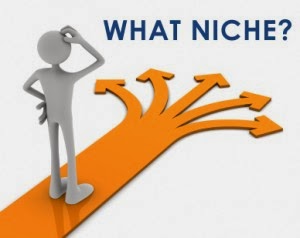
It means that if you want to stand out, Google forces you to stay in your niche. Thinking “out of the box” is not allowed! That’s tough for writers (like me) who are broadly interested in the human condition. Posting about all sorts of different subjects weakens your status as an expert: for Google, you can’t be an expert in a vast array of things.  

Because Google’s algorithms confuse expertise with critical thinking. The two are not the same. You can be an expert in your domain and a very poor critical thinker. The ability for critical thinking depends more on how you appraise a situation than on how much you know about it.

Go tell Google computers!

Looking at my blog as a whole, the experience has been positive: my readership has grown steadily overtime and lately I’m getting more and more comments. That’s a real satisfaction and I’m thankful to those of you who have taken the time to comment. But I worry. Have I done something wrong? Like any writer, I aspire to get my fiction read by the greatest number. Does that mean I should do like my fellow writers, discuss books and writing problems etc?

The trouble is I don’t often feel like “talking shop”. My interests are varied and to talk shop, there are plenty of wonderful writers’ and readers’ communities like Goodreads, Shelfari, TheNextBigWriter, ReadWave, Authonomy etc and I’ve joined them all, at one point or another.

It all boils down to one question: who should the blog be for? I believe it’s a two-way street. A blogger needs an audience. You always write for somebody, to either convince or entertain that person or both. You need to ask yourself what kind of audience inspires you and stimulates you – and write for that audience. Because if you’re not stimulated, you can’t write. At least, that’s the way it is for me. If my blog is not exclusively aimed at other writers  that’s because I just can’t limit myself to other writers. When I blog, I have in mind  all sorts of people and their problems and not just writers and writing. Sure, writers interest me too. The upheavals caused by the digital revolution make publishing a particularly fascinating subject and I want to know as much as I can about it and share that knowledge. But for me, the world doesn’t end there.

Am I wrong? I guess only time will tell…when my blog hits the 10,000 visits a day mark!

I have a question for you and I’d be grateful if you could drop a word in the comments below. Am I right to go out in all directions or should I focus on a niche and write only about books, the publishing industry, writing techniques? Do you enjoy reading my posts that are never twice about the same subject or would you prefer to visit my blog knowing exactly what you are going to find? As a writer, are you also tempted to blog beyond any given “niche”? After all, writers are observers of the “human condition”, and that means their interests cannot be contained in a “niche”…

Photo credit: Visit Carol Manser’s post “How to Choose a Good Niche Blog Topic”, on My Second Million blog, click here.

Enhanced by Zemanta

5 Comments

Filed under Blogging

Which Country Reads The Most?

Astounding…I knew the US and UK were not the top reading markets, but I hadn’t realized they were so far DOWN the list! And my Italian friends who always feel embarrassed for belonging to a “non-reading” country should take heart: they’re doing even better than the UK!

The International Indie Author's avatarMark Williams - The International Indie Author

GoGlobalIn2014_500 Which country reads the most? You won’t be surprised to learn it’s not America. In fact, the USA kicks in at an embarrassing #22 on the list.

This side of the pond you can probably hear the guffaws of laughter and see the knowing smiles from us Brits, Obviously we’re in the top five. Probably at number two after some boring European country like Belgium, where they have nothing better to do all day than read.

Yeah, we all love cliched national stereotypes. But as anyone who’s actually been to Belgium will tell you, It’s great little country and full of surprises.

One surprise is that while France is at number six on the list of countries that read the most, Belgium doesn’t even make the top thirty.

The UK? if you’re British and thought #22 was embarrassing for America, prepare to hang your heads in shame. Britain ranks even…

View original post 245 more words

1 Comment

Filed under Uncategorized

What you learn in your 60s

Baby Boomers Haven

So many 50th anniversaries of Baby Boomer milestones to celebrate these days, from the Beatles appearing on the Ed Sullivan Show fifty years ago to President Kennedy’s assassination. And expect a lot more, since the Baby Boomer generation spans 18 years of history (1946-1964). Moreover, in 2014 all boomers, even the youngest ones born in 1964, are passing the 50 mark and most boomers are now facing the transition to the second act in their lives.

Time to figure out what the sixties decade means. What I’m going to say here is based on my own experience. When I left behind a lifetime career at the United Nations, I thought I was going to enter into a wonderful period of R & R (rest and recuperation). Hey, I deserved it! But no, it didn’t pan out. Too much to do. There was my writing, I wanted to renew with my childhood dream of becoming an artist. But I hadn’t stopped being a wife, a mother (two grown-up children) and…a daughter. My Mom, 100 years old and still thriving, reads one novel a week on her Kindle.
So here goes.

  • The biggest transition is realizing that you’re the “sandwiched generation“. In spite of all the hype about how rebellious Baby Boomers have changed History, the truth is very different. Most of us are not into politics or big events. We find we are responsible for both our old parents and our children. The parents may not be in their dotage quite yet, but they need care. Our children in some cases may still be toddlers (a result of the fashion for late marriages), but for most of us, they are grown-up. With the on-going recession, chances are they’re home, struggling to find a job. As parents, we are happy to have them around, but it’s impossible not to worry about their future.
  • You’ve finally know the distance between the real world and the ideal one. The distance is big and no one can pull a fast one on you.
  • There may be no “soul mates”, you’ve known there weren’t since you were in your 40s, but you can distinguish between your real friends who will help you and those who won’t. This is perhaps the most surprising thing: it’s still possible to make new friends in your 60s.
  • You learn more about yourself, more than you ever thought possible. The last time you learned so much was back when you were in your late teens and early twenties. That’s exhilarating. And frightening. For us writers, that transition to greater self-knowledge is a fantastic fount of inspiration to write novels (indeed, that’s what inspired Louis Begley with his About Schmidt series or my own Crimson Clouds, a romance featuring a man who’s just retired and wants to become an artist to the dismay of his wife).
  • On a lighter note: You see the good side of things more easily than before. You’ve learned to appreciate the simple things in life and honest friendship – because now you trust your judgment and you know you’re not going to live forever. Carpe Diem! Catch the joy in each day and spread it around.
  • On a yet lighter note: Now you can buy those tight jeans, you’ve learned to control your weight (about time too!)

Photo credit: Baby Boomers haven, ThinkPanama.com

+++++++++++++++++++++++++++++++++++++++++++++++++++++
Cover Wars: Vote for your favorite book cover and don’t forget to vote mine, (grin) it’s “Crimson Clouds”.  Check it out here. They all look great (even if I really like mine)!
+++++++++++++++++++++++++++++++++++++++++++++++++++++


Enhanced by Zemanta

4 Comments

Filed under Baby Boomers

Simenon, Some Lessons from the Grand Daddy of Genre Literature

English: Georges Simenon Português: Georges Si...We all know that Simenon is the father of Commissaire Maigret, a fat policeman in the French Brigade Criminelle with a penchant for staring down suspects, and that all through the 20th century he was considered a literary phenomenon.


But exactly how phenomenal is not so well known. 

For example, I didn’t know that he had written some 250 novels in his lifetime, plus 150 novellas as well as three autobiographical novels. Or that it took him about 10 days on average to write a book. Or that he regularly wrote (and published) three books a year. 


I recently watched on ARTE TV 7 a documentary that cobbled together a series of interviews with Simenon and snippets of the numerous films that were made from his books. 

It was an eye-opener. 

What was nice about this documentary is that you only got Simenon talking about himself and his work, no silly comments from an off-line voice. Simenon even regaled us with a couple of old childhood songs (saying that was the advantage of growing old, you could remember them). He sang in a croaky voice totally out of tune and laughingly admitted to having no ear. 


Here’s the link to ARTE if you want to view the film: click here. And I hope for you that the link works – it doesn’t here in Italy where I live, I have no idea why. Instead, I found this video on YouTube, done in 2003 by Arte to celebrate Simenon’s 100th anniversary (born in 1903, he died in 1989). It  does work and provides a lot of the same info:


Before I get to the gems he dropped about himself, here are some breaking news of my own about Luna Rising, not really a genre novel…Sorry about that Simenon! We are compatriots, I’m Belgian too, but we haven’t followed the same path, I don’t write detective stories (grin). Actually, my Luna Rising is the ultimate cross-genre novel, starting out as a paranormal romance and ending as a techno-thriller when Tony Luna, an American computer whiz kid finds his start-up under attack from the Russian and Sicilian mafia in an unholy alliance. The stakes rise when the woman he loves is kidnapped in Moscow… (Hello Simenon, here I get closer to you!)

+++++++++++++++++++++++++++++++++++

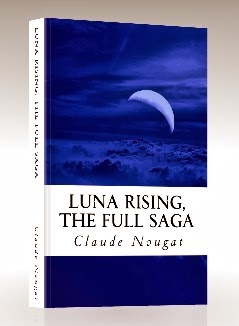
BREAKING NEWS: AMAZON COUNTDOWN DEAL for Luna Rising, the Full Saga (volumes 1-3) starting today 27 February at 99 cents and climbing by one dollar each day, $1.99 on 28 February, $2.99 the day after etc until it’s back to its original price of $4.99. Don’t miss out on the deal, get your copy before the price goes up! Grab it here

+++++++++++++++++++++++++++++++++++


Back to Simenon’s gems:

  • Family and religion: By the time he was 12, he realized he couldn’t stand his family or the Catholic religion, he saw them all as victims of the system and that was something he didn’t want to become, in short, he was (nearly) a born rebel;
  • Politics: He never got interested in politics because he felt politicians didn’t have power; the real power in his view, was always in the hands of big corporations and big banks;
  • Writing pulp: Colette was his mentor, the first critic of his works and she told him off for writing in a literary form; “make it simple” she chided him, “no extra words, no unnecessary descriptions, read  pulp fiction!”; he did, he read every cheap book he could lay his hands on, and within months started to produce his detective stories – the Maigret series, some 75 books – saying that they were really easy to write: the plot was pushed forward by the Commissaire himself!  
  • Writing speed: He wrote on an old typewriter, hitting the keys as fast as he could and never going back (in those days, corrections were a time-consuming process): he liked Bach fugues and all his life, wished he could write at that speed, keeping the rythm!
  • Branding and Book Promotion: He launched his first Maigret book through a fantastic PR operation: he rented a theater and threw a huge party in Paris that he called the “bal anthropométrique” asking his guests to put their thumb on real police ID cards (!); it was reported the next day in the Figaro, and voilà, his book became an instant success!
  • Literary Relationships: He didn’t like literary types – he felt they were a closed group, a mutual-admiration society that he never wanted to belong to yet he became great friends with André Gide , the grand old man of French letters. Gide astounded him with the first question he asked when they first met: “Where did you first get the idea for your ‘personnage’?” Simenon thought he meant “character” and that he was asking him about Commissaire Maigret; but that wasn’t the case at all. Gide wanted to know how he, Simenon, had come across the concept of his image – the image he projected in the literary world!

In fact, I think that is what is most interesting about Simenon: he is not only one of the founding fathers of genre literature but also a master at “brand” building. 


He certainly does look like everybody’s idea of a detective and a writer rolled into one!

What all this suggests for today’s digital writer is:

1. If you can, don’t stay entirely digital – try to create social events in real life with real, physical readers!


2. Pick a persona and stick to it, brand building is a daily job.

3. Read in the genre you’ve picked to write in and read as extensively as you can;


4. Write fast, write a lot (Simenon was capable of writing up to 80 pages a day) and don’t edit anything before you’re finished so that you don’t lose the momentum.


And one last thing: good luck!


What’s your take on Simenon’s lessons for fellow writers? And as a reader, do you enjoy him?


Photo credit: see Georges Simenon Wikipedia

Enhanced by Zemanta

1 Comment

Filed under book marketing, genre fiction, Literature

Is the Amazon Ebook Market Model Broken?

English: A Picture of a eBook Español: Foto de...

Is Amazon about to drop self-published writers? Is there any reason why it shouldn’t if self-pubbed titles clog its Kindle Store, making it look like a hastily published slush pile? After all,  the ebook market is reportedly only worth 7% of total Amazon sales and it’s not showing much signs of growing.Yes, that’s not a typo. Ebooks sales are worth only seven percent of total sales to Amazon. Think of Amazon as a virtual WalMart – in fact, I suspect that is the real goal of Amazon, to become the biggest digital department store in the world. The publishing industry is only a side-show for Amazon.

So, if much is wrong with Amazon’s ebook market model, it is not likely that Amazon will care. And perhaps that explains the uneven performance of Amazon in foreign markets where it’s not the only player in town, by a long shot. For example, it is striking to see how Kobo is ubiquitous in Italy, it has its devices on display in most major bookstores but you don’t see Amazon’s Kindle anywhere. According to Ebook Bargains UK, Kobo has made many mistakes in expanding abroad (see first article listed below). Maybe so, but it is still doing pretty well…
Let’s list the challenges facing Amazon:
1. the payment system –  Amazon’s model for expanding abroad has proved to be antiquated; Amazon has followed the old system of expanding abroad with geographically based “offices/virtual store fronts” rather than going global digitally; this means, for example, that New Zealanders are forced to shop in its Amazon Australia beachhead. Why not have a global easy-to-pay system like Google Play (for example, they very successfully use carrier billing in the Far East)?
2. ebook subscription services and digital libraries: Amazon has ignored this new business model, presumably relying on its own Premium system – but how long will they stay out of that particular game? And if they do go in, how will the Big Five react? It’s very likely that they won’t like it and could withdraw their books from Amazon’s shelves. A conundrum for Amazon.
I’ll be honest with you, those subscription services really worry me. I’m speaking of Scribd, and Oyster, the two major subscription services and Overdrive, a digital library. The latter has managed to get one hundred million ebook downloads in 12 years, up to 2012! See here. A huge number.
That (to me) is terrifying, the start of a new trend that could change the shape of the book market forever.
The problem with an ebook is that it is not an object you hold in your hands. It’s nothing, it’s like a bubble of soap. You can’t feel a liking for it the way you might view an old book as an old friend, sitting there on your library shelf in your home. You don’t own it, it’s essentially a digital service, a permanent access to a text available up there in the cloud, somewhere on the Net.
So why own an ebook at all? Why not pay less and get access to the text for the time you need to read it?
Many authors I know are complaining about a slump in sales. This is anecdotal, I can’t prove it. My impression is that the slump which first hit the sales of new, emerging writers in early 2013 has now affected midlist authors (i.e. traditionally published authors that have recovered their rights to their backlist and systematically self-publish those out-of-print titles on Amazon).  These are the very writers who were most successful in the Kindle Store, hitting (at least for a short time) the top 100 rank with every new title they uploaded. They could count on their fans to buy their new titles. Well, it seems they no longer do; 2013 was a stagnant year for many.
Where have all the fans gone? Who knows. But the expansion of subscription services and digital libraries surely acts as a syphon on the market. You as an author may get better known to many more readers thanks to such services, but you are also likely to make a lot less money in future. To what extent this will happen cannot be foretold.
Let’s look at possible solutions.   
One thing that could be done is to fix the Kindle Store. And re-organize good gate-keeping systems to help in book discovery and let “the cream rise to the top”.
For the time being, the way things are in the Kindle Store, the cream cannot rise to the top. And the reason is very simple and can be told in one word: rankings!
To understand why this is so, let’s look first at what’s happened in the environment. Since 2012, the ebook market has changed dramatically. First, the settling of the DOJ case against Apple and the way that has played out seems to have calmed the nerves of the (now) Big Five. They have become more aggressive with their pricing, slowly but surely edging out indies.  Price was the self-published writer’s biggest weapon, it no longer is. We all know that “free” doesn’t work anymore and I fear that “cheap” doesn’t work either. Books under $9 scream out to the readers “beware, this is a self-published work likely to be full of typos and badly structured”.

And then there’s the matter of sheer volume of published titles. The tsunami of self-pubbed authors has totally changed the environement. I know what I’m talking about, some of my books, like the earlier ones I published are buried under one million books or more! Literally buried under and forgotten. That’s because Amazon publishes everyone’s ranking. I’ve complained about this before and done so publicly on this blog only to get comments from indies like “Oh, but nobody pays attention to ranking”. That may have been true once but it no longer is. Readers are savvy and they’ve learned how to navigate Amazon’s Kindle Store. Readers do look at rankings, I’m convinced of it. And the theory that “quality books rise to the top like cream” is a non-starter. How can they rise if readers before buying glance at the ranking and decide it’s not worth buying because the book is sitting down there at the bottom of the ocean of published books?

In other words, the Amazon environment has become toxic. Even Kobo, the latest one on the Big Boys scene, also exhibits rankings. BIG mistake. Rankings should be reserved for the top 100 selling titles, maybe the top 1000 but no more! Then, and only then, if your book is good, you might have a fighting chance to rise with good reviews

If you still have doubts, take a look at the ranking of books that you know for a fact are good. I’ll do it here with just one book as an example, but do take time to navigate the Kindle Store and you will see. The example I want to use here is Amelie Nothomb’s “Fear and Trembling” (see here). Now this is easily a masterpiece of French literature, one of the best books published in the last 15 years. She’s a huge success with young adults, hardly your dowdy old writer. And it is probably the best book she ever wrote, lively, fun, suspenseful, not at all a high-brow literary bore. Yet, in the Kindle Store she is sitting at a ranking around the 300,000th range and has only 46 reviews!! This says a lot about the Amazon environment…

Speaking of reviews…What is truly missing is a gatekeeper system to keep out poorly edited books and help readers find quality reads. Amazon regularly makes efforts to improve its customer review system and sweeps out reviews that are deemed misleading (the famous “sockpuppet” reviews). Unfortunately, when Amazon does that, it creates a lot of discontent among writers and doesn’t really solve the problem.

Perhaps what Amazon should do is set up a two-tier system, with customer reviews and expert critiques.

Most customer reviews are not professional in the sense that they are not comprehensive reviews touching on all aspects of a book (i.e. character development, plot structure, POVs and writing techniques etc).

They are merely opinions written by readers.

Don’t misunderstand me. That is how it should be: a customer has a right to voice his/her likes and dislikes and we authors are very happy when they do, we love to be in touch with our readers! That’s one of the best things about the digital revolution: it has given us, writers, the possibility to be close to our readers and that’s wonderful. But a customer review is not the same as a professional critique, fully structured and substantiated by evidence and references to literary criteria.

This suggests that there is space for two different types of reviews, the customer reviews and the literary critiques. And perhaps an online website linked to Amazon should collect all those critiques and list them for each title…It could be a start towards a system to guide readers to the better reads and finally allow the “cream to rise to the top”.

Any other ideas?

Photo credit: wikipedia

Enhanced by Zemanta

6 Comments

Filed under book marketing

Is Amazon Supremacy in eBooks Threatened?

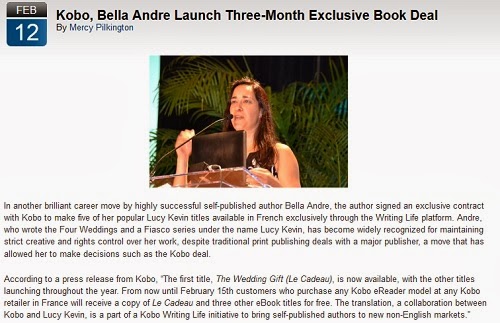
Wow, super star Bella Andre has given full confidence to, no…Not Amazon Kindle Select but Kobo!

See here:

For me, this is surprising news. I’ve always thought of Amazon as the giant e-retailer whose supremacy could not be threatened – not yet and not for a long time. I guess I was wrong.

What we have here is a David vs. Goliath fight, who will win?

As the savvy chaps at Ebook Bargains UK write (see here), the deal is “only for three months, and it’s for five French-translated titles, but she could just as easily have gone into Select and gone exclusive for three months with Amazon France. This is very a big-selling indie author. One of the indie super-stars. The fact that she’s gone exclusive with Kobo when she could take her pick of any of the big retailers and get similar terms is worth pondering.”

What they suggest is that “if you spend 90% of your time promoting Amazon listings, are in and out of Select, and all your links on your blog, website, email header, etc, etc, are to Amazon then you have only yourself to blame for the readers you are not reaching.” (highlight added)

Right so. Are you linking to other places than Amazon? I know I’m guilty of relying on Amazon up to 90%, and in some cases 100%.

How about you?

Post-scriptum: I was wondering why Bella Andre might have signed up that exclusive with Kobo and a little check on the Net turned up some very interesting facts (see here, an illuminating Jeremy Greenfield article in Forbes.com dated August 2013). 

In the US, Kobo is minuscule (around 3% of the ebook market) but abroad it’s doing well, particularly in Canada and Japan but also Brazil and India, both fast-growing huge markets. But, compared to Amazon, what Kobo is doing that is different is:
1. establish a physical on-the-ground presence (it has just signed up with 500 American booksellers and it is certainly present in bookstores here where I live, Italy).
2. focus on readers and e-readers – the reader experience is at the heart of their ethos, or so they say, whereas, as we all know, Amazon sells all sorts of things besides books. 

Whatever…Kobo must be doing something right! I have no doubts that in France a lot of people read books on Kobo devices – no question, that is probably the bet Bella Andre made when she signed up with them. 

Related articles

Kobo is Expanding in All Directions – Drops Hints of a Russian Kobo Store & Signs New Bookstore Partner in Spain(the-digital-reader.com)

Enhanced by Zemanta

3 Comments

Filed under book marketing

The Digital Revolution: What Published Authors Really Want

Best selling author Hugh Howey has set up a really cool website to encourage authors, both traditionally and self-published, to come together and (eventually) form a “guild” – or some sort of association to defend authors’ rights against publishers and e-distributors.

To visit, click here. To reade his latest report on author earnings and the state of publishing, click here. Inter alia, it raises an interesting question: are trad publishers losing customers by charging the highest prices in the industry?

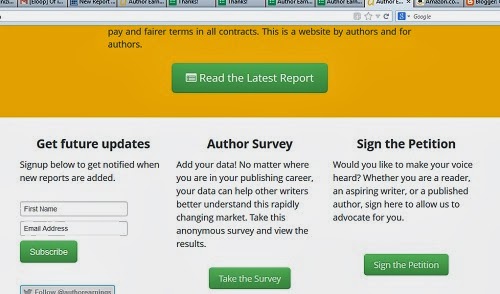
Here are the services offered on the home page:

In my (modest) view, it’s about time too and I’m very grateful to Hugh Howey for daring to come out and call people together.

Writers of the World Unite!

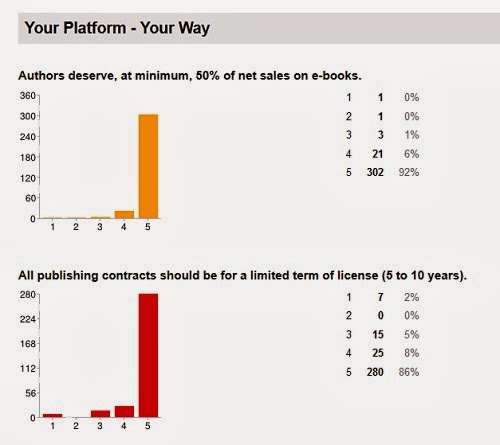
I’ve answered the survey and signed the petition (you can see it here). It  makes a lot of sense to me. And look at the analysis of early responses (the day I signed it was 331and 96% of them writers, both published and aspiring):

Clicking 5 means full support, 1 means little/no support. Fascinating, go take a look at the requests!

What I do like about his approach is that he is calling on both traditionally and self-published authors. That’s really the right approach, we are all in this boat together…

Your views? Do go take a look and if you feel like it, please sign the petition. It is also opened to readers and I think that it is right that it should be so. It is in the readers’ interest that their favorite writers should be treated right and make a decent living…

Enhanced by Zemanta

Comments Off on The Digital Revolution: What Published Authors Really Want

Filed under book marketing, writers rights

Two Good Reasons Why You Should Do Audiobooks

Should you do audio books of your titles? The answer is YES! And there are two very good reasons for doing so, but before I get to them, here’s a little introduction to the world of audiobooks.

It’s a new aspect of the digital publishing industry, now worth $1.6 billion (still peanuts) but growing fast. If you’re considering doing an audiobook, I highly recommend the following article by Michael Kozlowski on Good E Reader’s blog, click here. You will see that in addition to Amazon’s services, there are several excellent alternatives you might want to investigate.

Audio titles so far are relatively few (13,255 titles came out in 2012, up from 4,602 in 2009 – compare that to the millions of ebooks). Audiobooks seem to be the province of affirmed writers with a proven market, like, for example Elizabeth Spann Craig, a successful “hybrid” author (“hybrid” means she has both traditionally published books  and self-published titles). She has a hefty number of published books under her belt and writes 3 to 4 books a year, making sure they’re available in ALL formats. See here for her own summing up of her experience in 2013.

What is remarkable about her is that she spends (next to) zero $$$ on marketing, does just a little blogging and facebooking and tweeting (plus a couple of giveaways on Goodreads/year) – in short, she doesn’t relate directly to her readers as an author. They are more interested in her books than in her, they’re fans of her book characters, not of her as a writer or even as a person! This is what she calls “book-centric reader engagement” (and she is engagingly shy and modest about herself). All that means she has to write more books every year to keep it up rather than waste time on book promotion campaigns.

This is where audio-books come in, a format with a rapidly rising audience as more and more people are engaged in activities that preclude reading (for example, all the time wasted driving your car). We’ve all heard of Audible (acquired by Amazon in 2008), ACX and Podiobooks and I won’t go into it here. One of my fellow author friends, Bert Carson, who’s just dived into turning all his titles into audio-books, waxes enthusiastic, check him out here. He’s got a lot to say about making them (see his “lessons learned” sections).

What I do think is that before you make that extra effort of producing an audio-book you should consider whether it is really worth your while. Which gets me to the reasons for doing audiobooks:

Reason #1: You should definitely do an audio book if you are in Spann Craig’s position, where you’ve “saturated” your corner of the market. If not, you’ll find that your audio-books face the same marketing hurdles as all your other formats (ebooks and printed versions) and are in need of selling boosts. Are you ready for that extra-marketing?

But there may be alternatives. For example, producing audio-clips of portions of your book, say a particularly breathtaking passage that could help in marketing your book, though the places to upload your clips are still essentially limited to soundcloud.com, click here to visit. You can set up your “sound” page there and share your clips – also very useful to embed your clips on your blog or website.

Reason #2: with the advent of Amazon’s “Whispersync For Voice”, it makes total sense. Your readers are able to move from reading to listening and back again without losing the place they stopped reading (or listening). Check it out here. The cool thing is that Amazon provides readers with a discounted audio copy if they buy the ebook first. So what you’ve got here is a built-in marketing tool. See here author Stephen Woodfin’s experience that he very kindly shares on the Venture Galleries blog, an eye-opener.

If you’ve had any experience with recording your book, please share!

Latest News about my publications:

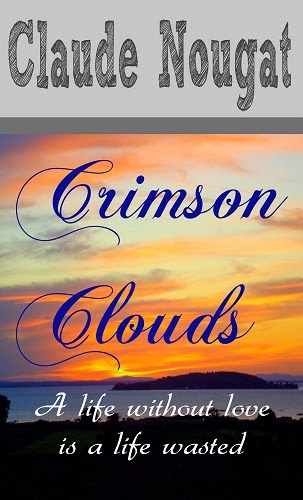
Crimson Clouds, (new edition) romance the second-time-around (on Amazon, click here for ebook and here for printed version) Just garnered new three 5 star reviews (excerpts):

“Honest, profound and emotional, Crimson Clouds will have you exploring some of your own emotions and question the meaning of your own life” (Bill Howard);

“The scenes unfold vividly in front of you, full of color and life, like a painting” (Mamta Madhavan);

“By allowing each of the main characters to narrate their side of the story, Claude Nougat skilfully delivered a must-read novel, enabling the reader to have a deeper understanding of the thoughts and feelings of each character” (Faridah Nassozi)

Beware of the offer of a printed first version of the book, under the title “A Hook in the Sky”, see here. It looks nice and cheap ($10.80!) but it’s no longer in print and I have retired it. It’s just that the Amazon system is slow to register change…

Luna Rising, the full saga (new edition, 3 volumes) one young man’s battle to rebuild the family name (on Amazon, click here for ebook and here for the printed version)

Again, beware of the printed version presented  here, it’s cheaper BUT that is the first edition (originally called “Fear of the Past”) and unless you are a collector of rare editions, don’t buy it!

Note: ebook is 40% off compared to buying each e-volume of the saga separately. See here.

Enhanced by Zemanta

2 Comments

Filed under Uncategorized

When an Audio Clip Turns Into a Radio Show

Fantastic job done by the Director of the HighRock Institute Joel Scott and his partner Angela Castonguay. This is a fiery dialogue taken from CRIMSON CLOUDS, my just released romance. What was going to be a sample audio clip was suddenly turned into something quite different, like a radio drama show, with two beautiful voices, male and female, screaming at each other…You can hear it directly on Sound Cloud here , or click below:

Congrats to Joel and Angela! I highly recommend them, they did a superb job, don’t you agree? If you want to use their services, click here to contact them, you can read their latest blog post on audiobooks, “does an audiobook make sense for you?”, click here.

Listening to that dialogue, think of Robert looking like (ideally!) George Clooney:

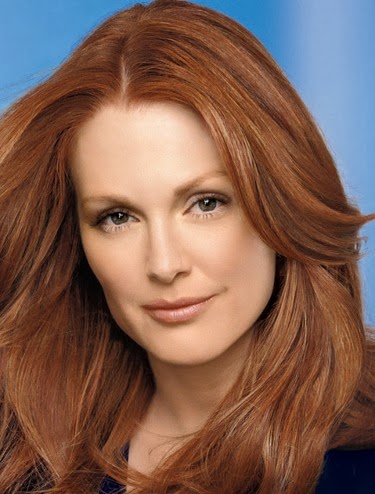
And Natasha like Julianne Moore:

Are you wondering what happens next? Is Robert going to get back to Natasha or will other women enter his life? And what about his wife? If you’re curious, you can get the book here.

Looking at the future of audiobooks:  the dialogue you just heard was extracted from Chapter 16 and of course, in the novel, it’s embedded in the text that describes the reaction of each character. However, using more than one voice to read from a book opens up the possibility of theater-like dialogue that, in my opinion, is far more effective and lively than a straightforward reading of the book.

I wonder whether audio-books could be systematically done that way…though it would require extra editing from the author because of the need to turn the dialogues into self-standing pieces and of course, it would require a high level professional reading perfomance.

This suggests that novels re-formatted that way  would stand half-way between theater and straight fiction.

What do you think, would that editing effort be worthwhile? It could be the start of yet another way for telling a story, an alternate format…

Enhanced by Zemanta

Comments Off on When an Audio Clip Turns Into a Radio Show

Filed under Uncategorized

Are Mammograms Useless in Screening for Breast Cancer?

This morning the New York Times trumpeted the  news that “mammograms fail to cut risk of death and causes overdiagnosis”, apparently the result of a major Canadian study involving 90,000 women over 25 years (to read the article, click here). For women like me who’ve been undergoing mammograms ever since we turned 40, this is nothing short of astonishing. Now we find we’ve been taken for a ride all these years, really?Not quite. It is a little more complicated than that.

First, let me be honest about this and tell you on which side I fall. I’ve had my doubts about the usefulness of mammograms for a long time, ever since I had a surgical intervention back in the 1980s, with the removal of an 8cm tumor from a breast – a tumor that resulted benign and the whole operation could easily have been skipped with a simple biopsy (but in those days in Italy, and with the conservative MD I had, a biopsy was not considered as reliable as total removal). What really annoyed me at the time was the obvious fact that the mammogram hadn’t revealed anything more than what was already known via a simple palpation.

So why do it at all? Anyone who’s gone through a mammography knows how unpleasant it is, a machine that squeezes you flat in order to supposedly “photograph” better what’s under the skin. Machines have improved since early days and are no longer so invasively painful, but it is still a deeply unpleasant experience.

Now my doubts are confirmed. It is an unnecessary experience. What the Canadian study shows without a shadow of a doubt are two things:

1. early detection of “lumps” do not change ultimate results in terms of number of lives saved because many of those super tiny lumps that only a mammogram shows actually disappear of themselves or never evolve to a cancerous stage; hence the overdiagnosis and “false positives”.

2. what has changed are recent improvements in medical cures (e.g. drugs like tamoxifen) that have improved the survival rate for women (and men) with breast cancer.

So should we abandon mammograms? As I said earlier, not quite. They are still a useful adjunct after a normal palpation exam by your doctor has shown a problematic lump. But don’t expect wonders from it. Just a confirmation of your doctor’s exam. 

I honestly believe that mammography, once touted as a fantastic means to “catch” cancer at an early stage, thus improving chances of survival, has done its time and is ready to be shelved in historic medical libraries. Even if it never really did anything more than a simple palpation could do, it still served a historic role in drawing women’s attention to the problem of breast cancer. 

Your views?

English: Mammography in process: Shown is a dr...Mammography in process: Shown is a drawing of a female having a mammogram. A mammogram is a picture of the breast that is made by using low-dose x-rays. (Photo credit: Wikipedia)

Comments Off on Are Mammograms Useless in Screening for Breast Cancer?

Filed under Uncategorized