
Europe and China could change the course of History as Trump’s America First policies move America to the sidelines…Here’s the opening of my new article, just published on Impakter:
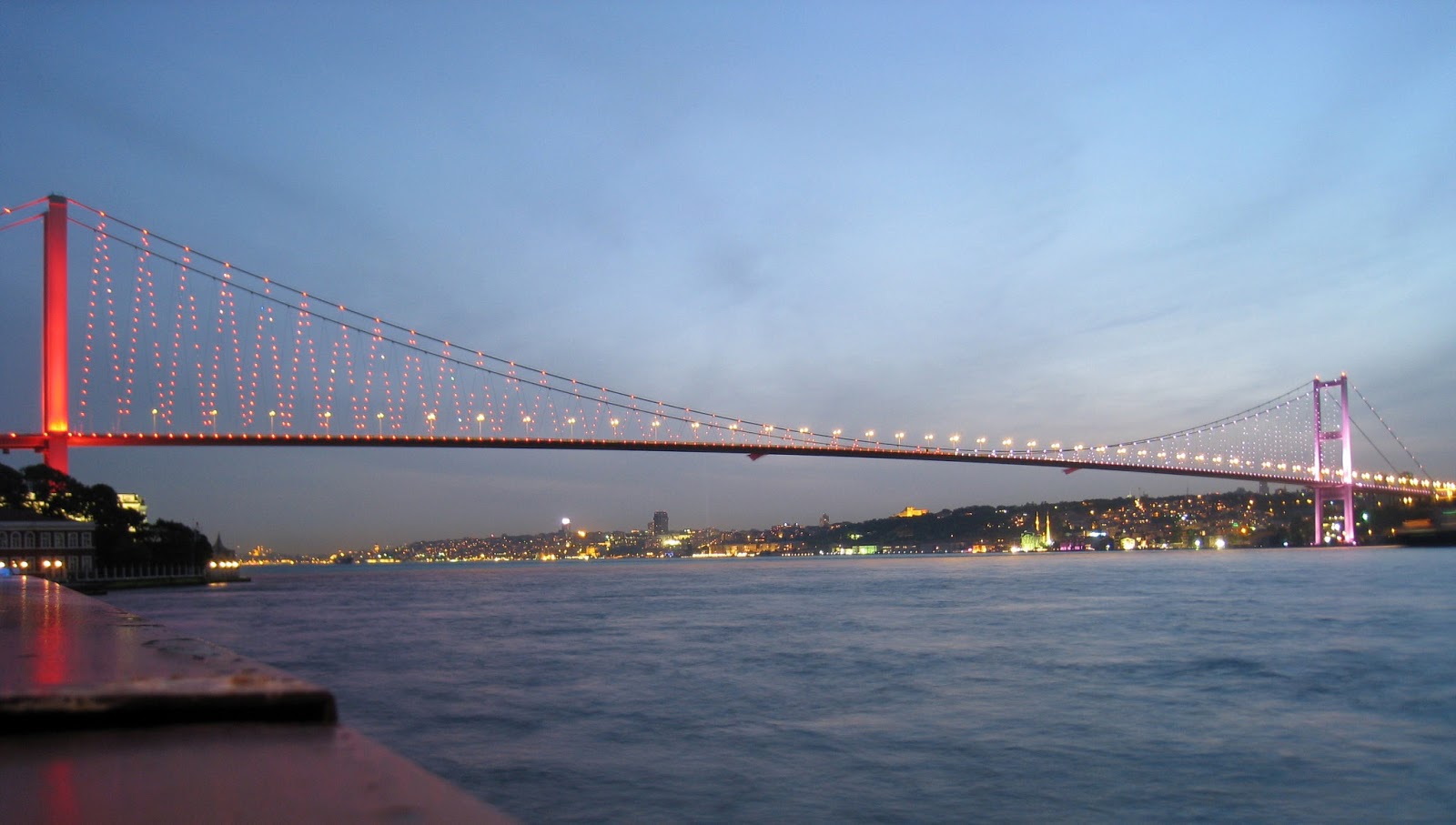 |
| Bosphorus Bridge (Turkey) linking Europe to Asia – PHOTO JORGE1767 |
How will the future play out? Will Europe follow America’s example and sink into nationalist populism that will inevitably tear apart the European Union and open the way to Trump’s divide-and-conquer America First strategy? Will America’s trade war with China escalate in a real war that could go global as Trump’s stranglehold on world trade tightens further? I believe there is hope that neither will happen. Instead, we might witness something utterly different and much more likely: the rise of Eurasia.
Two events these days are early signs of such a shift for anyone who cares to look. One just took place in Paris at the 100th anniversary of the end of World War I organized by French President Macron. The other, thousands of miles away in Singapore, is the ASEAN Summit, from 11 to 15 November where a major new trade deal, the Regional Comprehensive Economic Partnership (RCEP) that for the first time included China, was on the agenda.
The trip was a diplomatic disaster for Trump. He started on the wrong foot even before leaving for Paris. On 9 November, Trump, misunderstanding a Macron statement about the formation of a “true European army”, sent an insulting tweet:
Emmanuel Macron suggests building its own army to protect Europe against the U.S., China and Russia. But it was Germany in World Wars One & Two – How did that work out for France? They were starting to learn German in Paris before the U.S. came along. Pay for NATO or not!
— Donald J. Trump (@realDonaldTrump) November 13, 2018
The misunderstanding was soon clarified: Macron had referred to the announced U.S. withdrawal from the I.N.F. nuclear arms treaty with Russia as a reason for establishing an independent army, not that the U.S. was an enemy. Macron in a speech welcoming 84 world leaders to the celebration on November 11, made another statement that shook Trump who considers himself a nationalist:
“Patriotism is the exact opposite of nationalism. Nationalism is a betrayal of patriotism by saying: ‘Our interest first. Who cares about the others?’ I do defend my country. I do believe that we have a strong identity. But I’m a strong believer in cooperation between the different peoples, and I’m a strong believer of the fact that this cooperation is good for everybody.”
From the ashes of the two World Wars came hope, he said. “This hope is called the European Union, a union freely entered into, never before seen in history, a union that has freed us of our civil wars”. Trump appeared “grim” and “clapped only tepidly” afterward. Significantly he missed the opening of a 3-day conference, the Paris Peace Forum that followed the ceremony to discuss how to strengthen multilateralism.
The next day, on 13 November, Trump took again to Twitter in a series of five aggressive tweets, astonishingly rude and misinformed, including this one:
The problem is that Emmanuel suffers from a very low Approval Rating in France, 26%, and an unemployment rate of almost 10%. He was just trying to get onto another subject. By the way, there is no country more Nationalist than France, very proud people-and rightfully so!……..
— Donald J. Trump (@realDonaldTrump) November 13, 2018
Not the way to treat the leader of an American allied country. He forgets (or doesn’t know) that his own approval rating in France is abysmal (around 9%). Macron was forced to respond. France, a historic ally, is “not a vassal state” he said in an interview on French TV: “At every moment of our history, we were allies, so between allies, respect is due. I don’t think the French expect me to respond to tweets but to continue this important history.”
Now that Angela Merkel is on her way out and Brexit is wobbling to its pell-mell conclusion – barring a last-minute legal reversal or a political crisis – there is no doubt that Macron is emerging as the main defender of a United States of Europe. A Europe increasingly under assault by Trump’s America First policies.
Meanwhile, at the other end of the Euroasian continent, in Singapore, RCEP is the second major trade deal under discussion since Trump ditched the Trans-Pacific Partnership (TPP) in January 2017. A serious political blunder considering that the goal of the TPP in the Obama administration’s intention, had been to exclude China. In March 2018, the situation had been reversed and it was America that was isolated: the remaining TPP members (including Canada and Australia) signed the first major Pacific trade agreement, keeping the original TPP content largely intact but renaming it the Comprehensive Progressive Trans-Pacific Partnership (CPTPP) – to take effect soon, on 30 December 2018.
Brookings Institute experts see the new RCEP as something much bigger, “an optimistic answer to populist and protectionist trends around the globe”.
Massive, the new RCEP brings together 16 countries covering 3.6 billion people for a total GDP of some $25 trillion, exceeding that of the United States. The point is that it brings China in for the first time, together with India, Japan and South Korea. It builds on commitments already taken in the World Trade Organization (WTO). Not without difficulty of course. Of the 21 chapters of the treaty, so far agreement was obtained on only seven.
RCEP negotiations are expected to be completed only at the next ASEAN summit in Thailand in 2019. Predictably, problems range from India’s fear of being overrun with products from China, Korea and Japan to Trump’s trade wars, making some countries anxious of “losing” the American market.
How Likely is Eurasia to Replace America as World Leader?
Euroasia: A little used term for a vast continent that extends from Cape Dezhnev (Russia) in the East to the Monchique Islet (Portugal) in the West to Dana Island (Indonesia) in the South. A new geo-political entity that is not yet born. The road is rocky but if it emerges, it will be the largest ever, encompassing two-thirds of the world population.
…
Find out! Read the rest on Impakter, click here.


 Claude Forthomme's Blog about Social Issues and Books