
Image via Wikipedia
Dear Readers,
Some of you may know me from my site on blogspot.com and I’ll try to keep you posted on both sites, with comments on politics, books, art (everything I like) and economics (everything I dislike!) – in short, our world as I see it. But since this is just a bunch of personal opinions, you’re most welcome to shoot them down!
I love a rousing discussion!
Here is my take on what is happening to the publishing world as it has to face (and survive) the tsunami of the digital revolution…If you disagree, please make comments!
The sales of e-books have outpaced printed books for the first time this year at Amazon, the number one on line bookseller in the world. People are talking about the digital revolution being something as big, nay, BIGGER than Gutenberg’s invention of the printing press around 1440. We’re into a new age, the possibilities are infinite, everything will change!
Does that mean that the printed book is dead and that traditional publishers are on their way out?
No, I don’t believe so. I am convinced the future of publishing is anything but bleak! By the way, I’m looking at it as an economist and political analyst – not as an aspiring fiction writer (which I also happen to be, but that’s incidental – for that matter, I’m also a painter – which has nothing to do with the argument at hand…). I just wanted to point out that I’m trying to evaluate the situation in a detached, scientific way (hum, gasp, cough).
The first thing to realize is that e-books are NOT going to eat into the current market. The pie, with the advent of digital titles, will expand. E-books will add to the book market in general, bringing in lots of new readers – people who after a first jolly experience on their i-pad or kindle will go on to buy paper books for the first time in their lives! And remember, digital editions are forever. They’re not like printed books, sitting on your local bookstores shelves for a few weeks and then gone. E-books are FOREVER! Which means they are accessible, ready to be downloaded on your e-reader anytime. You don’t have to go to the book store to order and then wait for the book to be sent by mail. No, e-books are just a click away!
Second, as with any BIG change in an industry’s parameters, expect a wave of bankruptcies and consolidations. The biggest bookstore in the US, Borders, has gone into receivership which means, inter alia, that traditional publishers have lost miles of physical shelf space for their books. Talk of a tsunami! You can expect that over the next few years, even the Big 6 (the main American publishers) will have to reconsider their marketing strategies, their costs and do everything they can to ensure their survival – perhaps even move out (gasp!) of Manhattan! And expect some to go under. That may not be fun for those involved, but it’s physiological. When structural change comes to an industry, only the fittest survive.
Bookstores, however, are at this moment taking the brunt of the storm (as shown by Borders). They need to react ASAP and become more imaginative to turn themselves into welcoming places, like Starbucks and provide coffee to attract clients or organize conferences and local contests to engage the community. There are a number of bookstores of that sort in Europe, places that straddle the Internet and offer a haven to the local community, and they seem to prosper. Advisory services could also be provided to their clients, things like advice on e-readers, the best apps, and help them locate interesting stuff to read on Internet – that is, turn themselves into “gatekeepers” of sorts, to guide people in the jungle of e-books.
Because it’s fast becoming a jungle: there are lots and lots of titles out there. If you look at the top 100 best-selling titles on Kindle, you’ll be amazed at the BIG proportion of self-published books – I didn’t count, but at a glance, it’s much more than half! To find “good” authors (in the sense of “good read”) is becoming a well-nigh impossible enterprise. I know because I do that repeatedly for my mother who’s 97 and an avid reader (she loves her Kindle). You get the feeling that the famous “slush pile”, all those manuscripts rejected by publishers and literary agents as “unfit to print”, all of them are suddenly on sale. And, perhaps more surprisingly, they are finding customers! Yes, people do buy these books! Sure, they’re priced at $O.99 so that’s probably why people buy them. But the more successful e-authors who started at that price, have found they could jack up their price to $2.99 and more (but always well under the $9.90 borderline established by traditional publishers) and still make money…in spite of the lack of editing, poor plot structure and typos… Which goes to show that a good yarn sells more easily than “literature”.
That may be a depressing thought for some but it’s definitely a golden opportunity for others: with the expansion of the book market, a lot of “unsophisticated” first-time readers have been drawn in, and they’re the sort of people who enjoy a good story and don’t care too much about how it’s told.
This means that one of the traditional roles of publishers of printed books, i.e. being “gatekeepers” to ensure a “minimum” level of “quality”, has been seriously weakened and others could jump in the void. Magazines and papers and blogs with a big following that review books are doing that job now, but why not bookstores? And the big bookstore chains could consider providing print-on-demand services for all things digital. Indeed, that’s where the real competition for printed books might yet come from…
To sum up: with the digital revolution, everybody’s role is changing, and it’s not just bookstores that have to rethink themselves. Publishers also need to reconsider their role. They often give the impression of being on the defensive as they progressively tighten their contracts with writers and lower advances. Six-digit figures are a rarity nowadays. Publishers even cut advances up in 4 parts, meant to follow the different stages in the publishing process, and that means you get only 1/4th of your “advance” upon signing the contract. Sure, this is a tough business, they try to get the most out of every deal. But writers are publishers’ natural allies: writing is the source of their business. So publishers need to realize that if they stop scraping authors naked, and instead treat them right, they will make of them faithful allies. I am willing to bet that the first publishers who realize this will see their prospects turn for the better real fast. And the first thing they should consider doing is giving authors a better deal on e-book royalties and making a better job of providing supportive book marketing. Because in this Internet age, the buzz word is king, and authors, through such important blogs as Writer Beware learn real soon who are the publishers to avoid…
Because e-rights are forever and more and more writers are realizing this. And more and more are unwilling to give up returns on their books forever when all the publishers have done is a one-time investment in them. After all, the money you have to put up front to get yourself e-published is relatively small – just about anyone can afford to do it. Of course, not everyone has the necessary on line presence and the desire to spend all that time into marketing one’s book.
Most writers would still prefer to spend most of their time writing…
So there’s a glimmer of hope for traditional or “legacy publishers”. There will be more Amanda Hockings who after establishing themselves as self-published wonders (she made one million dollars in her first year of digital self-publishing), will be coming back into their fold. And there will be probably fewer Barry Eisler walking away from them. Remember him? He is that feisty writer who refused a $ 500,000 advance from St.Martin’s Press for two books. But then, on closer examination, it wasn’t really such a good deal: $250,000 per book minus the 15% going to his agent, plus the fact that he’d get next to nothing for his e-rights. And, remember, e-rights are forever!
The real challenge for legacy publishers will be the midlist authors who can make a big buck turning their back list into e-books. Joe Konrath‘s success is an example for all midlist writers. Publishers will just have to figure out a way to get into that juicy market – and they won’t get into it unless they bend their position on e-rights. They want too much for far too long. They really should consider another model, for example putting a time frame on e-rights and allow authors to regain them after, say, 5 years, but – and that’s an important “but” – with a renewal clause for another 5 years on condition that the publisher agrees to engage in some additional marketing. That would encourage writers to sign up with them rather than go the self-publishing e-route.
AND they need to provide a service of value to the authors, in particular marketing support (that’s something writers normally don’t like to do: if you’re a writer, let’s face it, you’re an introvert, you really don’t have a salesman personality…) Publishers could easily make sure their authors get reviews, and not any kind of reviews, but good ones from respected reviewers with a known and proven following.
And they could consider doing something else too, something no one talks about much because it’s scary: I’m referring to piracy. Yes, publishers could try and provide more effective means to fight off piracy. Individual authors are not well-placed to defend themselves and few are internet-savvy. To fight off piracy requires experts. Pirates – I mean hackers – are getting better all the time and a lot of people out there, a writer’s regular readers, don’t even think that downloading a book for free is a form of criminal offense. The author has sweated over writing his book and deserves a fair $ return for his pains. Let’s face it, pirate are pirates and should be jailed. Now, in the digital world, that’s hard to do and it requires huge means to properly police the Internet. And it means publishers and e-book sellers will have to work together.
Because, let’s face it, the biggest danger the digital revolution brings to the publishing industry is PIRACY! It might yet bring together everybody: Amazon.com, traditional bookstores, e-book platforms and publishers, both those into “legacy” publishing and e-books, for the greater good of authors and their readers…But then I’m an incorrigible optimist!

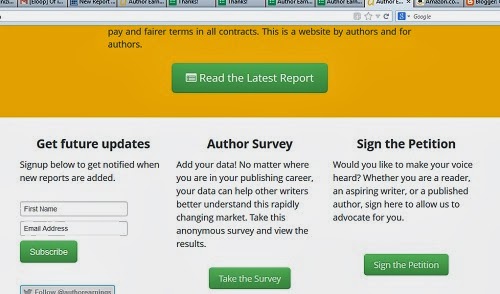
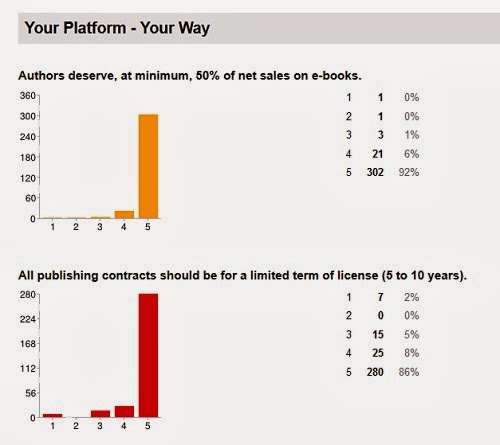
 Hugh Howey explodes your view of publishing with author earnings report(teleread.com)
 Go Read This | Hugh Howey’s Report On Author Earnings(eoinpurcellsblog.com)
 This chart ought to make the publishing industry very nervous(io9.com)




 Claude Forthomme's Blog about Social Issues and Books