Tag Archives: Five Star Movement

Italy: What the New Government Means for Europe

Yesterday was amazing, suddenly Italy had a new government! In this article, just published on Impakter, I explore what it really means:

On 31 May, Italian politics took an unexpected, spectacular turn. President Mattarella approved the very government he had vetoed – as was his constitutional right –  four days earlier. Now the two big winners of the March elections, Luigi Di Maio’s Five Star Movement (M5S with  33 percent of the votes), and Matteo Salvini’s The League (17 percent) finally got what they wanted.

It had taken 88 days of hard negotiations to get there. And the unlikely alliance between an extreme right party (The League) with a centrist party (M5S) that has socialist roots (in the Partito Democratico, or PD). Both are populists and anti-establishment, The League with its base in Northern Italy and support from business, M5S with support from young people and the South and a fluctuating political platform shaped by social-media.   Di Maio and Salvini had hammered a 56 page contract for a so-called “government of change” and selected as premier an unknown non-politician, the economist Paolo Conte.

What made Mattarella change his mind? Much of it appears to be the result of unexpectedly nimble political work on the part of Di Maio, who, despite his youth and lack of experience, is apparently endowed with unusual political instincts. Improbably, after insulting Mattarella and calling for his impeachment, he withdrew the accusations and instead met the President eye-to-eye. And was  able to change his mind. The idea of a “technical” stop-gap government to prepare a return to the polls was abandoned and Conte came back with a new list of ministers.

What is remarkable is that the new list had only one notable modification: Paolo Savona, the Euro-skeptic 81 year-old economist Mattarella had objected to, was moved from Treasury where he had been originally assigned at Salvini’s request, to Minister for Relations with Europe.

An apparently slight correction but a significant one: Savona’s new position is much weaker than at Treasury, he is a minister without portfolio (i.e. without the support of a full ministry). The new man in the Treasury post is Giovanni Tria, a well-known economist with a long career both nationally and internationally – in short, a more moderate figure.

HAVE POPULISTS TAKEN OVER THE ITALIAN GOVERNMENT?

On the next day, the international press, even staid and serious journals like Bloomberg, reacted with emotional headlines: the Populists have surged to power in Italy! They will take Italy out of the Euro and Europe!

Despite the scary headlines, investors took it in stride, and even welcomed the “stability” that a new government implied, as the Wall Street Journal was quick to note. In short, they have set aside the likelihood that Italy will exit the Euro.

Yet, the new man at Treasury, Giovanni Tria is really not very different from Paolo Savona. He agrees with Savona on Europe and that a reform of the Euro is essential. On the face of it,  pulling Savona from one key Ministry to another less powerful position seems like a gratuitous game.

How come markets are reassured by Tria and scared by Savona? What do investors know that the journalists don’t, what really happened?

THE REAL STORY BEHIND SAVONA’S REPUTATION

First, the scare over Savona was vastly exaggerated – almost a case fake news.

Read the rest on Impakter, click here.
Comments Off on Italy: What the New Government Means for Europe

Filed under politics, Uncategorized

Italy 2018: Politics Shaped by Social Media

We are worried here in Italy with the way politics are playing out, a big mess. I just wrote about it on Impakter, here is the opening:

Italian politics is notoriously complex and unfathomable. One reason is that Italy often ventures in uncharted waters, foreshadowing the future. Today, Italy is the first big democracy in the West where social media gave birth to a leading party, the Five Star Movement (Movimento Cinque Stelle, M5S). Twenty-five years ago, Italy was where a media mogul famously won power: Berlusconi, an early version of Trump, served four times as Prime Minister between 1994 and 2011.

M5S won 11 million Italians, a third of the votes in the elections, two months ago. Since then, gridlock.  One of the worst in Italy’s convoluted political history.

Will M5S be better for Italy than Berlusconi?

Italians are weary, they all remember Berlusconi’s broken promises of reform, the endless series of sexual scandals (the Bunga-Bunga girls), the deeply embedded corruption that led to his being barred from running again (that prohibition was just lifted, he is now free to run again).

In short, since Berlusconi, the businessman turned populist-politician, appeared on the political scene, two decades of growth were lost.

With M5S, things may turn out differently but it doesn’t look promising. So far, M5S has given the Italians the usual spectacle of politicians hungry for power, with Luigi Di Maio, the young M5S leader initially demanding the job of premier – despite his youth (he’s 31) and total lack of academic credentials (he’s a college dropout), work or government experience.

How come M5S can’t express better candidates?

The Populist Roots of M5S

The party was anti-establishment and populist from the moment it was founded in 2009 by Beppe Grillo.  Who is Grillo? Very different from Berlusconi, he was in his fifties when he emerged on Internet, a (failed) comedian and political satirist, exiled from public television, but  a (successful) blogger whose main appeal was with the discontented. And back then, there was plenty of unhappy people.

The 2008 Great Recession had spread to Italy, causing unheard-of levels of unemployment, one the highest in Europe, especially among the young (over 40 percent). Waves of immigrants hit the coasts, turning into a tsunami with the Syrian war. And Italy, shackled by the rigid Euro rules, could not solve its problems with a quick devaluation, as it had regularly done with the Lira in the previous century.

Result? A strong dislike for Europe and hatred for the Euro, seen as the source of all the problems. Beppe Grillo was supremely adept at exploiting this discontent.

The rest on Impakter, click here.

Comments Off on Italy 2018: Politics Shaped by Social Media

Filed under politics, Uncategorized

Elections in Italy: Why They Matter for Europe and the World

My latest article on Impakter, here’s the opening:

Imagine the following result from the March 4 vote in Italy: either the populist Five Star Movement led by young Luigi Di Maio (he’s 31) or the conservative right coalition, led by Berlusconi (he’s 81) and firebrand Salvini, gets an absolute majority.

What happens next? The pro-European left coalition, with the Democratic Party (PD) in the lead plus various small parties, notably Emma Bonino’s +Europe, is sent in the opposition. The head of the current government, Paolo Gentiloni and the PD secretary, Matteo Renzi, both go home.

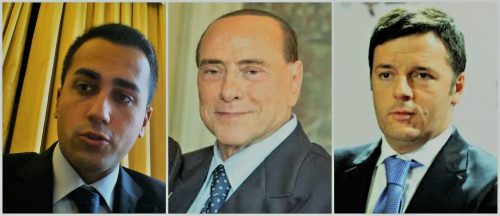
italian-elections-collage-di-maio-berlusconi-renzi-with-neo-filter-e1519462767404

From Left to right: M5S Leader Luigi Di Maio; Silvio Berluconi (right coalition); Matteo Renzi  (left coalition, PD leader)  SOURCE: WIKI COMMONS

In either case, Europe, already weakened by Brexit and threatened by the rise of “illiberal democracies” on its Eastern front (in Hungary and Poland), would be shaken to its foundation.

Why?


To find out and read the rest, click here.

Comments Off on Elections in Italy: Why They Matter for Europe and the World

Filed under European Union, politics